DJI Mini 5 Pro Fly vs DJI FPV Drone Combo Remote: Spec Comparison
See how the DJI Mini 5 Pro and DJI FPV compare using factory specifications. Review differences in camera sensors, total weight, flight controls, and video transmission.
As Amazon Associates, we earn from qualifying purchases. This means we may receive a small commission at no extra cost to you if you click through and make a purchase.
As an Amazon Associate we earn from qualifying purchases. Links on this page are affiliate links.
This dji mini 5 pro fly vs fpv drone combo remote comparison evaluates two distinct flight platforms from DJI. Both drones record 4K video at 60 frames per second to capture sharp motion. The primary difference centers on flight style and design. The Mini 5 Pro is a sub-250-gram foldable drone tailored for aerial imaging, while the FPV combo provides an immersive cockpit view with dedicated goggles and high-speed flight.
Sensor size
1-inch CMOS
not listed
Obstacle sensing
Omnidirectional
Forward and downward
Weight
249.9 g ± 4 g (8.78 oz)
1.75 lb
Flight time
Up to 36 min
not listed
Transmission range
not listed
Up to 6.2 miles
Choose the first if
- You want a lightweight, palm-sized drone that weighs under 250 grams.
- You need omnidirectional obstacle sensing, vertical shooting, and up to 36 minutes of flight time.
- You prefer a 1-inch CMOS sensor with ActiveTrack 360° subject tracking.
Choose the second if
- You want an immersive first-person flight experience using FPV Goggles V2.
- You prioritize a 150° super-wide field of view with high-speed hybrid S mode flight.
- You need a transmission system specified for ranges up to 6.2 miles.
Verdict
Select the DJI Mini 5 Pro if you need a compact camera drone with omnidirectional safety sensors and automated tracking for standard aerial videography. Choose the DJI FPV Drone Combo if you want high-speed manual maneuvers and real-time first-person flight through dedicated goggles. Each platform serves a distinct flying purpose based on whether you prioritize imaging portability or immersive piloting.
DJI Mini 5 Pro vs DJI FPV
Sensor size and video capabilities
Edge: DJI Mini 5 Pro 1-Inch CMOS Drone
The DJI Mini 5 Pro features a 1-inch CMOS sensor that records 4K video at 60 frames per second in HDR. It also includes true vertical shooting and a 225-degree roll rotation for diverse camera angles. In comparison, the DJI FPV records 4K video at 60 frames per second with a high bitrate of up to 120 Mbps. However, its exact sensor size is not specified in the manufacturer data. The Mini 5 Pro gives you HDR capture and a known 1-inch sensor, providing clear technical details for imaging. If sensor size and flexible shooting orientations matter to you, the Mini 5 Pro holds the advantage.
Obstacle sensing and flight safety
Edge: DJI Mini 5 Pro 1-Inch CMOS Drone
The DJI Mini 5 Pro uses omnidirectional obstacle sensing paired with forward-facing LiDAR and vision sensors. This system detects obstacles in all directions to assist you during flights and automated return procedures. In contrast, the DJI FPV provides forward and downward obstacle sensing alongside an auxiliary bottom light. The FPV also includes Smart Return to Home and Low Battery Return to Home functions for safety at higher velocities. While the DJI FPV covers front and bottom hazards, the DJI Mini 5 Pro protects your craft from all directions, giving you greater spatial coverage around trees, walls, and structures.
Flight perspective and field of view
Edge: DJI FPV Drone Combo with Goggles
The DJI FPV is built around an immersive piloting format. It includes the DJI FPV Goggles V2 and offers an ultra-wide 150-degree field of view. You also get access to S mode, which blends manual flight mechanics with simplified DJI controls. The DJI Mini 5 Pro uses standard visual monitoring via the DJI RC-N3 remote controller and your connected smartphone. It is targeted at beginners rather than immersive FPV piloting. For high-speed perspective and an enclosed cockpit feel, the DJI FPV gives you dedicated goggles and a much wider 150-degree lens perspective.
Weight class and portability
Edge: DJI Mini 5 Pro 1-Inch CMOS Drone
Portability depends heavily on takeoff weight and frame dimensions. The DJI Mini 5 Pro features a palm-sized foldable frame with a takeoff weight of 249.9 grams, or roughly 8.78 ounces. It also provides 42GB of built-in internal storage for quick deployment without extra memory cards. By comparison, the DJI FPV weighs 1.75 pounds and measures 12.3 by 10 by 5 inches in a rigid airframe. It requires more pack space for both the craft and the bulky goggles. If you need a lightweight aircraft that packs down small for travel, the DJI Mini 5 Pro holds the edge.
Transmission range and connectivity
Edge: DJI FPV Drone Combo with Goggles
The DJI FPV features the OcuSync 3.0 transmission system. This protocol provides low-latency high-definition video streaming across distances of up to 6.2 miles. The published specifications for the DJI Mini 5 Pro Fly More Combo do not declare a maximum transmission range figure. The Mini 5 Pro package pairs with the DJI RC-N3 remote controller and requires the DJI Fly app, which you must download directly from DJI's website. Because the DJI FPV documents verified transmission capability up to 6.2 miles with its remote and goggles setup, it provides a confirmed operational boundary for long-distance link stability.
Flight time and power management
Edge: DJI Mini 5 Pro 1-Inch CMOS Drone
Flight duration dictates how much aerial work you accomplish per outing. The DJI Mini 5 Pro delivers up to 36 minutes of flight time per Intelligent Flight Battery. The Fly More Combo package includes three batteries and a charging hub capable of powering all three packs in approximately 115 minutes. The published technical data for the DJI FPV does not state a flight time rating or charging duration. Because the DJI Mini 5 Pro provides a verified 36-minute runtime alongside three included batteries, you can plan extended shooting sessions with dependable battery figures.
Choosing Your Ideal DJI Drone
Pilots wanting first-person cockpit flight views
Our pick: DJI FPV Drone Combo with Goggles
You get DJI FPV Goggles V2 paired with a 150-degree field of view for immersive piloting. Hybrid S mode provides manual-style control alongside basic handling assists. OcuSync 3.0 delivers low-latency HD video feeds over distances reaching 6.2 miles. Auxiliary bottom lighting and forward and downward sensors support safe high-speed navigation.
Travelers needing extended flight time and compact weight
Our pick: DJI Mini 5 Pro 1-Inch CMOS Drone
You gain a lightweight 249.9-gram foldable airframe that stores easily in small compartments. Up to 36 minutes of flight time per battery lets you stay airborne longer. The Fly More Combo supplies three batteries and a charging hub. Built-in 42GB internal storage ensures you keep recording without relying solely on external memory cards.
Solo creators tracking fast outdoor action
Our pick: DJI Mini 5 Pro 1-Inch CMOS Drone
You get ActiveTrack 360 degrees to follow subjects automatically during activities like cycling. Nightscape omnidirectional obstacle sensing uses forward-facing LiDAR and vision sensors to monitor surroundings in all directions, increasing safety in dim conditions. The included RC-N3 remote controller connects to your mobile device, keeping subject tracking workflows direct and dependable.

DJI Mini 5 Pro 1-Inch CMOS Drone
Best for: sub-250g aerial filming with a 1-inch sensor
- Video Resolution
- 4K/60fps HDR
- Sensor Size
- 1-inch CMOS
- Takeoff Weight
- 249.9 g ± 4 g
- Flight Time
- Up to 36 min
- Obstacle Sensing
- Omnidirectional
- Target Audience
- Beginners
The DJI Mini 5 Pro is a lightweight folding drone with a 249.9-gram takeoff weight. It features a 1-inch CMOS sensor recording 4K video at 60 frames per second and includes omnidirectional obstacle sensing. With three batteries offering up to 36 minutes of flight each and 42GB of internal storage, it suits beginners who need extended capture time.
- 1-inch CMOS sensor with 4K/60fps HDR video capture
- Sub-250g takeoff weight (249.9 g ± 4 g)
- Omnidirectional sensing with forward-facing LiDAR
- 42GB internal storage
- Up to 36 minutes flight time per battery
- DJI Fly app requires manual installation outside Google Play
- DJI RC-N3 remote controller lacks an integrated screen
- You want a sub-250g drone to simplify travel and flight regulations.
- You record content for social platforms using true vertical filming.
- You need obstacle detection during night flights and return-to-home routes.
- You require an integrated display screen on your remote controller.
- You prefer installing apps directly through the Google Play Store.
Verdict: DJI Mini 5 Pro Fly More Combo fits aerial photographers and travelers needing a sub-250g platform with a 1-inch sensor and automated subject tracking. The three included batteries provide over 100 minutes of total airtime for field shoots.
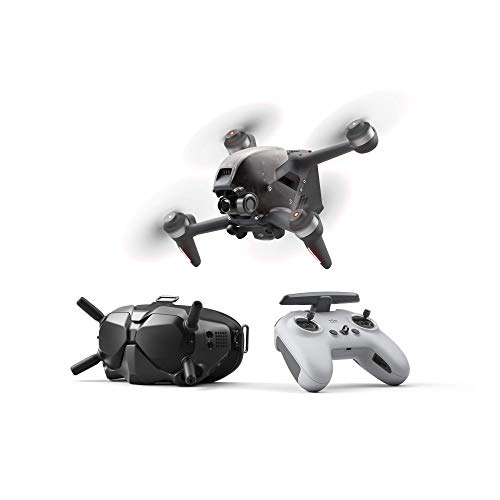
DJI FPV Drone Combo with Goggles
Best for: immersive first-person high-speed 4K flight
- Video Resolution
- 4K/60fps
- Obstacle Sensing
- Forward and downward
- Transmission Range
- Up to 6.2 miles
- Dimensions
- 12.3 × 10 × 5 inches
- Weight
- 1.75 pounds
The DJI FPV Drone Combo gives you high-speed flight with included FPV Goggles V2 and remote controller. It records 4K video at 60 frames per second with a 120 Mbps bitrate and a 150-degree field of view. An OcuSync 3.0 system provides video transmission up to 6.2 miles. This setup suits you if you want first-person perspective flight.
- 4K recording at 60fps with 120 Mbps bitrate
- DJI FPV Goggles V2 included with 150-degree field of view
- OcuSync 3.0 transmission up to 6.2 miles
- S mode for hybrid manual and simplified controls
- Obstacle sensing covers only forward and downward directions
- Heavier build at 1.75 pounds
- You want a 150-degree wide-angle view through dedicated flight goggles.
- You require 4K video recording at 60 frames per second.
- You need omnidirectional obstacle detection instead of forward and downward only.
- You want a lightweight drone weighing under 1.75 pounds.
Verdict: DJI FPV Drone Combo with Goggles fits pilots who prioritize fast first-person-view flight with wide-angle 4K60 capture over compact lightweight carrying.
Specifications side by side
| Spec | DJI Mini 5 Pro 1-Inch CMOS Drone | DJI FPV Drone Combo with Goggles |
|---|---|---|
| Video Resolution | 4K/60fps HDR | 4K/60fps |
| Sensor Size | 1-inch CMOS | – |
| Takeoff Weight | 249.9 g ± 4 g | – |
| Flight Time | Up to 36 min | – |
| Obstacle Sensing | Omnidirectional | Forward and downward |
| Transmission Range | – | Up to 6.2 miles |
| Target Audience | Beginners | – |
| Dimensions | 12 × 15 × 3.58 inches | 12.3 × 10 × 5 inches |
| Weight | 8.78 ounces | 1.75 pounds |
| Size | 7.00 | 12.3 x 10 x 5 inches |
| Color | Grey | Black |
| Model | 6937224123090 | – |
Frequently asked questions
Which drone is lighter to carry between the DJI Mini 5 Pro and DJI FPV?
The DJI Mini 5 Pro is significantly lighter at 8.78 ounces compared to the DJI FPV at 1.75 pounds. This sub-250g class build makes the Mini 5 Pro easier to transport in standard backpacks. The heavier frame of the DJI FPV supports high-speed flight stability instead of compact travel.
What obstacle detection features do these two DJI drones provide?
The DJI Mini 5 Pro features omnidirectional obstacle sensing to detect hazards in all directions around the aircraft. This comprehensive coverage helps protect the drone during automated tracking maneuvers. In contrast, the published specifications for the DJI FPV do not list omnidirectional obstacle sensing capabilities for your flights.
How do the camera specifications compare between the Mini 5 Pro and DJI FPV?
The DJI Mini 5 Pro includes a 1-inch CMOS sensor that captures 4K video. The DJI FPV also records 4K video, focusing on wide-angle capture during high-speed maneuvers. A 1-inch sensor provides a larger surface area to collect visual data, benefiting standard landscape filming and automated tracking shoots.
Which of these two drones is better suited for a beginner pilot?
The DJI Mini 5 Pro is designated for beginners. Its omnidirectional obstacle sensing and automated tracking simplify piloting while you learn flight basics. The DJI FPV is tailored for immersive high-speed piloting using video goggles, which demands quicker reflexes and greater manual control than a standard camera quadcopter requires.
What total airtime can you expect from the DJI Mini 5 Pro Fly More bundle?
The DJI Mini 5 Pro Fly More Combo provides over 100 minutes of total airtime using its three included batteries. This setup allows you to rotate power packs during extended field shoots without needing immediate recharges. The DJI FPV listing does not specify multi-battery flight times in its core specifications.
How do the dimensions of the DJI Mini 5 Pro compare to the DJI FPV?
The DJI Mini 5 Pro measures 15 inches wide, 12 inches long, and 3.58 inches high. The DJI FPV measures 10 inches wide, 12.3 inches long, and 5 inches high. While the Mini 5 Pro has a wider frame, its lighter 8.78-ounce weight offers an easier carry than the 1.75-pound FPV.
What flight viewing experience does each drone deliver?
The DJI FPV Combo includes goggles to deliver an immersive, first-person flight view directly in front of your eyes at high speeds. The DJI Mini 5 Pro focuses on traditional framing and aerial photography via automated subject tracking and a 1-inch CMOS camera, prioritizing stable footage capture over cockpit immersion.


