Autel Robotics EVO II Dual vs Autel Robotics EVO MAX 4T (2026): Key Differences
Examine 2 enterprise drones by sensor hardware, aircraft weight, and flight endurance. Learn how the EVO II Dual and EVO Max 4T differ based on published specifications.
As Amazon Associates, we earn from qualifying purchases. This means we may receive a small commission at no extra cost to you if you click through and make a purchase.
As an Amazon Associate we earn from qualifying purchases. Links on this page are affiliate links.
When analyzing the autel robotics evo ii dual vs robotics evo max 4t, you find two enterprise-grade platforms built for critical missions. Both aircraft share 640×512 thermal imaging sensors and utilize the Smart Controller V3. The main difference lies in payload versatility and obstacle detection. The EVO II Dual relies on modular add-ons with a rated 42-minute flight time, while the EVO MAX 4T integrates four sensors including 720-degree radar perception.
Camera configuration
Thermal camera (640×512) with modular enterprise accessories
Integrated 4-in-1 system (48MP wide, 48MP 8K zoom, 640×512 thermal, laser rangefinder)
Obstacle sensing
not listed
720° omnidirectional (dual fisheye vision and millimeter-wave radar)
Flight time
42 minutes
not listed
Transmission range
15 km (SkyLink 2.0)
not listed
Weight
2.5 pounds
2.4 pounds
Choose the first if
- You prioritize a verified 42-minute flight duration along with a 15 km transmission range.
- You require bundled hardware accessories such as a loudspeaker, spotlight, and beacon.
Choose the second if
- You need an integrated optical zoom camera with 8K recording and an onboard laser rangefinder.
- You conduct flights in complex areas requiring 720° radar obstacle perception and GPS-denied navigation.
Verdict
The EVO II Dual 640T Enterprise V3 suits deployments that require extended flight endurance and modular public safety tools. The EVO MAX 4T V2 serves technical inspection work demanding integrated zoom optics, laser distance measuring, and multi-sensor obstacle avoidance. Your choice depends directly on whether your mission needs specific payload add-ons or advanced autonomous sensing.
Autel EVO II Dual vs MAX 4T
Camera configuration and zoom
Edge: Autel EVO Max 4T V2 Multi-Camera Drone
You get significantly different imaging arrays between these two drones. The Autel EVO Max 4T V2 integrates four sensors into one payload: a 48MP wide camera with a 1/2-inch CMOS sensor, a 48MP zoom camera capable of 8K video with 10x optical zoom and up to 160x digital zoom, a laser rangefinder measuring from 16.4 to 3,737 feet, and a thermal camera. In comparison, the Autel EVO II Dual 640T Enterprise V3 focuses primarily on thermal imaging, featuring a thermal camera with 16x digital zoom. Because the EVO Max 4T V2 provides dedicated optical zoom, an 8K zoom camera, and a laser rangefinder, it offers substantially greater optical inspection versatility.
Flight endurance and batteries
Edge: Autel EVO II Dual 640T Enterprise Thermal Drone
Flight planning depends heavily on battery capacity and runtime. The Autel EVO II Dual 640T Enterprise V3 lists a verified maximum flight time of 42 minutes, supported by larger propellers, carbon fiber arms, and heat dissipation vents. Its bundle supplies three total batteries and a multi-charger. The Autel EVO MAX 4T V2 does not publish an exact maximum flight time in its specifications. However, it introduces the ABX41-D battery, which supports hot-swapping and battery in-place detection alerts. Its bundle contains one battery. Even with smart hot-swapping on the MAX 4T V2, the EVO II Dual delivers documented 42-minute airborne endurance and extra batteries right out of the box.
Obstacle sensing and navigation
Edge: Autel EVO Max 4T V2 Multi-Camera Drone
Navigating challenging operational environments demands reliable perception systems. The Autel EVO MAX 4T V2 features 720-degree omnidirectional obstacle sensing by combining dual fisheye vision cameras with millimeter-wave radar technology. This fusion system maps real-time 3D flight paths and enables navigation in GPS-denied or GNSS-unavailable zones, even near power lines or over water. The Autel EVO II Dual 640T Enterprise V3 provides an enterprise airframe rated for temperatures from -10 to 40 degrees Celsius, but its data does not list radar perception. For automated pathfinding around difficult obstacles without satellite signals, the EVO MAX 4T V2 delivers a noticeably more capable sensing platform.
Included enterprise accessories
Edge: Autel EVO II Dual 640T Enterprise Thermal Drone
Mission flexibility often comes down to the gear included in your flight kit. The Autel EVO II Dual 640T Enterprise V3 bundle includes dedicated enterprise accessories directly in the box: a loudspeaker, a spotlight, and a beacon. These modular tools mount to the airframe to assist search, rescue, and public safety operations. In contrast, the Autel EVO MAX 4T V2 bundle focuses on core flight hardware, packing the drone, controller, cables, chargers, and a rugged case without modular speaker or spotlight attachments. If your operations require immediate audio broadcasting or aerial illumination, the EVO II Dual provides those field attachments right inside the package.
Thermal imaging optics
Edge: Tie
Both drones share the same core thermal resolution but apply different optical focal lengths. The Autel EVO II Dual 640T Enterprise V3 provides a 640×512 thermal resolution at 30 frames per second, featuring a 13mm lens, 16x digital zoom, and multiple measurement tools like isotherms and alarms. The Autel EVO MAX 4T V2 also delivers 640×512 thermal imaging at 30Hz with 16x digital zoom, but couples it with a 9.1mm focal length. The 13mm lens on the EVO II Dual narrows the field for distant subjects, whereas the 9.1mm optic on the EVO MAX 4T V2 provides wider thermal coverage. Because each drone matches 640×512 resolution and 16x zoom, this round is a technical tie.
Choosing Your Autel Enterprise Drone
Public safety teams needing bundled mission accessories
Our pick: Autel EVO II Dual 640T Enterprise Thermal Drone
Select this model if you need ready-to-use hardware out of the box. You get three batteries and factory-supplied modular tools, including a spotlight, loudspeaker, and beacon. Its 42-minute flight time keeps you airborne longer, while the SkyLink 2.0 system maintains 15-kilometer tri-band transmission across operating temperatures ranging from -10℃ to 40℃.
Inspectors flying near power lines and structures
Our pick: Autel EVO Max 4T V2 Multi-Camera Drone
Choose this aircraft if you fly in challenging flight conditions. It uses millimeter-wave radar combined with binocular vision for 720° omnidirectional sensing. Its flight control systems counter RFI and EMI near power lines, while advanced autonomy allows you to navigate and identify targets in GNSS-unavailable or GPS-denied environments without losing route control.
Field operators managing coordinated multi-drone mapping missions
Our pick: Autel EVO Max 4T V2 Multi-Camera Drone
Pick this model if your workflow demands precision targeting and team coordination. It integrates an internal laser rangefinder measuring distances from 16.4 to 3737 feet. Built-in A-Mesh 1.0 networking supports dual-control handoffs, multi-device communication, and real-time information sharing between controllers during complex BVLOS operations and waypoint mapping tasks.
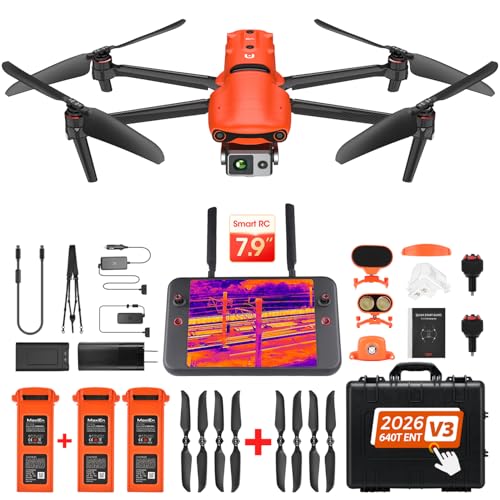
Autel EVO II Dual 640T Enterprise Thermal Drone
Best for: thermal inspection and public safety operations
- Flight Time
- 42 Mins
- Transmission Range
- 15 km
- Dimensions
- 9.6 × 5.1 × 4.4 inches
- Weight
- 2.5 pounds
The Autel EVO II Dual Thermal Drone pairs a 640×512 radiometric thermal sensor with modular enterprise accessories. You get up to 42 minutes of flight time, a 15-kilometer video transmission range via SkyLink 2.0, and a dedicated 7.9-inch smart controller. This platform gives you modular utility for inspections, search and rescue, and thermal tracking without requiring external mobile devices.
- Up to 42 minutes of flight time per charge
- 640×512 thermal imaging sensor at 30 fps with 16x digital zoom
- Dedicated 7.9-inch smart controller with 15 km SkyLink 2.0 transmission
- Includes modular loudspeaker, spotlight, and beacon attachments in the bundle
- RTK positioning module is not included in the standard bundle
- Digital magnification is limited to 16x
- You need a 640×512 thermal sensor with spot and regional temperature measurement
- You want a turnkey field kit that includes a loudspeaker, spotlight, and beacon
- You prefer an integrated 7.9-inch high-brightness smart controller instead of a phone
- You require centimeter-level RTK positioning straight out of the box
- You need extreme telephoto capability beyond 16x digital zoom
Verdict: Autel EVO II Dual Thermal Drone equips commercial inspectors, search teams, and public safety pilots who need dependable 640×512 thermal data and modular payload accessories in a compact airframe.

Autel EVO Max 4T V2 Multi-Camera Drone
Best for: Enterprise inspection and GPS-denied commercial operations
- Video Resolution
- 8K
- Sensor Size
- 1/2" CMOS
- Obstacle Sensing
- 720° omnidirectional
- Photo Resolution
- 48MP
- Dimensions
- 9.64 × 5.1 × 4.37 inches
- Weight
- 2.4 pounds
The Autel EVO Max 4T Quad-Camera Drone is a commercial platform built for complex mapping and inspection work. You get an integrated payload with a 48MP wide camera, an 8K 10x optical zoom sensor, a 640×512 thermal camera, and a laser rangefinder. It suits you if you need 720-degree obstacle avoidance and navigation in GPS-denied environments.
- Integrated payload with 48MP wide, 8K 10x optical zoom, 640×512 thermal, and laser rangefinder
- 720-degree obstacle sensing combining dual fisheye cameras with millimeter-wave radar
- Flight navigation and pathfinding capability in GPS-denied environments
- A-Mesh networking support for multi-device communication and dual-operator control
- Wide-angle camera uses a 1/2-inch sensor size
- Included bundle comes with only one battery
- You need thermal imaging paired with a 10x optical zoom camera on one craft.
- You fly in areas with RF interference or absent GNSS signals.
- You require dual-control support and mesh networking across multiple units.
- You require a primary camera sensor larger than 1/2 inch.
- You need a compact platform weighing less than 2.4 pounds.
Verdict: Autel EVO Max 4T Quad-Camera Drone delivers multi-sensor data collection for operators working in GPS-denied and high-interference environments. Its four-sensor gimbal handles simultaneous thermal, zoom, and distance measurements on commercial flight paths.
Specifications side by side
| Spec | Autel EVO II Dual 640T Enterprise Thermal Drone | Autel EVO Max 4T V2 Multi-Camera Drone |
|---|---|---|
| Video Resolution | – | 8K |
| Sensor Size | – | 1/2" CMOS |
| Flight Time | 42 Mins | – |
| Obstacle Sensing | – | 720° omnidirectional |
| Transmission Range | 15 km | – |
| Photo Resolution | – | 48MP |
| Dimensions | 9.6 × 5.1 × 4.4 inches | 9.64 × 5.1 × 4.37 inches |
| Weight | 2.5 pounds | 2.4 pounds |
| Size | 9.6 x 5.1 x 4.4 inches | – |
| Color | Orange | Orange |
Frequently asked questions
Which drone is lighter between the Autel EVO II Dual and EVO Max 4T?
The Autel EVO Max 4T V2 is slightly lighter. It weighs 2.4 pounds, compared to the 2.5 pounds of the Autel EVO II Dual 640T Enterprise. This 0.1-pound difference gives you a marginally lower takeoff weight without significantly changing the airframe dimensions during transport.
What are the physical dimensions of the Autel EVO II Dual 640T?
The Autel EVO II Dual 640T measures 9.6 inches long, 5.1 inches wide, and 4.4 inches high. These measurements give the drone a compact enterprise airframe that fits easily into standard transport cases alongside your thermal inspection gear and field accessories.
How do the dimensions of the Autel EVO Max 4T compare to the EVO II Dual?
The Autel EVO Max 4T V2 measures 9.64 inches long, 5.1 inches wide, and 4.37 inches high. Both aircraft share the exact same 5.1-inch width. The Max 4T is 0.04 inches longer and 0.03 inches shorter than the EVO II Dual 640T Enterprise airframe.
Which drone is better suited for GPS-denied environments?
The Autel EVO Max 4T V2 is built for GPS-denied and high-interference commercial operations. You can deploy it in complex environments where standard satellite navigation signals are degraded or completely unavailable, whereas the EVO II Dual is targeted primarily toward standard thermal inspection and public safety tasks.
What primary mission types is the Autel EVO II Dual designed for?
The Autel EVO II Dual 640T Enterprise is designed for thermal inspection and public safety operations. You can collect 640×512 thermal data and deploy modular payload accessories, making this compact airframe suitable for search teams and commercial inspectors who need dedicated thermal imaging capabilities.
What types of measurements can the Autel EVO Max 4T take simultaneously?
The Autel EVO Max 4T V2 captures simultaneous thermal, zoom, and distance measurements. Its four-sensor gimbal supports multi-sensor data collection across commercial flight paths. This allows you to gather different analytical data layers during a single automated or manual enterprise inspection mission.


