DJI or HOVERAir? Camera Drones Compared in 2026
Look at 2 camera drones from DJI and HOVERAir based on factory specs. Examine transmission range, gimbal stabilization, and automated tracking to choose your ideal device.
As Amazon Associates, we earn from qualifying purchases. This means we may receive a small commission at no extra cost to you if you click through and make a purchase.
As an Amazon Associate we earn from qualifying purchases. Links on this page are affiliate links.
Choosing between a DJI vs HOVERAir camera drone comes down to traditional flight versus automated tracking. Both devices offer compact, lightweight designs for aerial video without complex setups. The DJI Mini 4K focuses on long-range piloting with a 10-kilometer transmission range, 3-axis mechanical gimbal, and 31 minutes of flight time. In contrast, the HOVERAir X1 emphasizes hands-free self-flying modes, an enclosed frame, and localized internal storage for quick capture.
Video resolution
4K Ultra HD
2.7K at 30 fps, 1080p HDR
Flight time
31 minutes per battery
11 minutes per battery
Stabilization
3-axis gimbal
Triple stabilization system
Transmission range
Up to 10 km
not listed
Internal storage
not listed
32 GB
Weight
8.47 ounces (under 249 g)
4.41 ounces
Choose the first if
- You want 4K video stabilized by a 3-axis mechanical gimbal.
- You need long battery runs up to 31 minutes per flight.
- You plan to fly scenic distances reaching up to 10 kilometers away.
Choose the second if
- You want automated follow-me flight modes up to 15 mph without holding a controller.
- You prefer an ultra-lightweight 4.41-ounce frame with fully enclosed safety guards.
- You want integrated 32 GB internal storage without using separate memory cards.
Verdict
The DJI Mini 4K suits pilots who want manual control, 4K resolution, and extended range across wide outdoor areas. The HOVERAir X1 suits solo creators needing automated follow-me flight paths and safe, enclosed close-range recording. Your choice depends on whether you prefer piloting a traditional landscape camera or using a hands-free tracking assistant.
DJI Mini 4K vs HOVERAir X1
Video resolution
Edge: DJI Mini 4K Fly More Combo
DJI Mini 4K Fly More Combo records in 4K Ultra HD. It pairs this recording format with a 3-axis mechanical gimbal to stabilize footage in any lighting condition. The HOVERAir X1 Self-Flying Camera Drone tops out at 2.7K at 30 frames per second, alongside 1080P HDR video recording supported by a triple stabilization system. If you prioritize fine image clarity and cinematic landscape details, the DJI model holds a distinct advantage with native 4K capture. The HOVERAir provides capable high-definition output for casual recording, but it cannot match the pixel count or resolution ceiling delivered by the DJI camera hardware.
Flight time and battery endurance
Edge: DJI Mini 4K Fly More Combo
Battery longevity determines how long you can keep your camera in the air. The DJI Mini 4K Fly More Combo provides 31 minutes of flight time from a single battery, offering up to 93 minutes across its 3-battery set. In contrast, the HOVERAir X1 Self-Flying Camera Drone provides 11 minutes per battery charge, which translates to roughly 20 automated flight paths. While 11 minutes suffices for quick self-recording tasks, the DJI platform allows you to stay airborne almost three times longer per pack. For extended aerial exploration and continuous filming sessions without frequent landing, the DJI Mini 4K clearly leads this category.
Smart features and autonomous tracking
Edge: HOVERAir X1 Self-Flying Camera Drone
Autonomous tracking gives the HOVERAir X1 Self-Flying Camera Drone an edge for hands-free action recording. It features intelligent follow-me algorithms that track subjects at speeds up to 15 mph. It includes pre-programmed flight paths like Hover, Follow, Zoom Out, Orbit, and Bird's Eye, along with palm takeoff. The DJI Mini 4K Fly More Combo provides GPS Return to Home and QuickShots modes such as Helix, Dronie, Rocket, Circle, and Boomerang. However, the DJI lacks dedicated subject-following speeds and palm launch functions. For automated personal tracking during sports like cycling or skateboarding, HOVERAir gives you a more autonomous cameraman experience right out of the box.
Build and safety
Edge: HOVERAir X1 Self-Flying Camera Drone
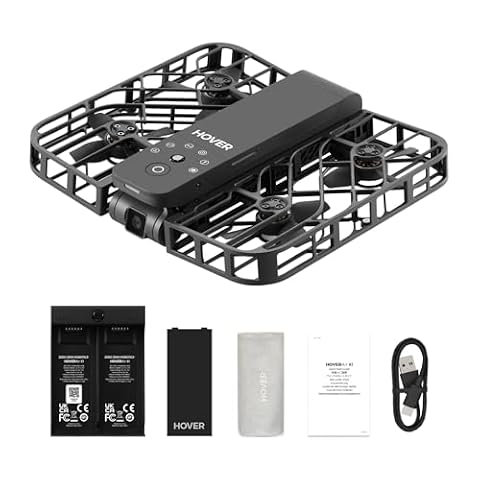
Airframe structure impacts where and how you safely fly. The HOVERAir X1 Self-Flying Camera Drone uses a fully enclosed cage design equipped with safety guards. This protective frame encloses the propellers, allowing close-range shooting near people or confined environments while protecting surrounding objects. The DJI Mini 4K Fly More Combo has exposed propellers on folding arms. While its takeoff weight sits under 249 grams to avoid FAA registration requirements for recreational flights, the open propeller design lacks built-in prop protection. If you want worry-free flying near yourself or friends at close distances, the enclosed structural design of HOVERAir delivers superior built-in physical protection.
Flight performance and wind resistance
Edge: DJI Mini 4K Fly More Combo
Operating in breezy outdoor environments requires robust motor power. The DJI Mini 4K Fly More Combo features brushless motors that provide Level 5 wind resistance against winds reaching 38 kph. It also supports takeoff altitudes up to 4,000 meters, ensuring reliable outdoor stability. The HOVERAir X1 Self-Flying Camera Drone does not publish a maximum wind resistance rating or operational ceiling in its specifications. Its smaller 4.41-ounce frame and specialized close-range tracking focus make it less suitable for high-wind conditions compared to the 8.47-ounce DJI. If you plan to fly along blustery coastlines or at high elevations, the DJI provides verified flight envelope stability.
Internal storage
Edge: HOVERAir X1 Self-Flying Camera Drone
Onboard memory simplifies media management after landing. The HOVERAir X1 Self-Flying Camera Drone includes 32GB of built-in internal storage. You can record footage directly to the drone without purchasing or formatting microSD cards, and you can download files through the Hover X1 app or via a computer connection. The DJI Mini 4K Fly More Combo does not feature integrated internal storage in its specifications, meaning you must supply your own external storage media to save aerial video. If you prefer capturing footage without worrying about missing memory cards or card compatibility errors, the HOVERAir offers an immediate advantage with its built-in capacity.
Choosing the Right Drone for You
Solo athletes wanting automated sports tracking
Our pick: HOVERAir X1 Self-Flying Camera Drone
You get hands-free subject tracking at speeds up to 15 mph, suited for cycling or skateboarding. Pre-programmed paths like Orbit and Bird's Eye run autonomously without a separate controller. Fully enclosed propeller guards protect your fingers during close-range operation, while 32GB of internal storage saves video directly without external memory cards.
Outdoor pilots needing extended flight time
Our pick: DJI Mini 4K Fly More Combo
You benefit from a 31-minute flight time per battery, extending up to 93 minutes across the three-battery set. Level 5 wind resistance handles gusts up to 38 kph, while the brushless motors permit takeoffs at altitudes up to 4,000 meters. GPS Return to Home safeguards your craft during open-air exploration.
Recreational pilots avoiding FAA registration rules
Our pick: DJI Mini 4K Fly More Combo
You stay exempt from FAA registration and Remote ID for recreational flights because the takeoff weight sits under 249 grams. One-tap takeoff, stable hovering, and automated QuickShots like Helix and Boomerang simplify operation for novices. In-app learning resources help you build flying skills quickly.

DJI Mini 4K Fly More Combo
Best for: long-range sub-249g 4K aerial video
- Video Resolution
- 4K UHD
- Takeoff Weight
- Under 249 g
- Flight Time
- 31-min (93-min with 3 batteries)
- Gimbal Stabilization
- 3-Axis
- Transmission Range
- 10 km (32,800 feet)
- Weight Class
- Under 249g
The DJI Mini 4K Fly More Combo is an ultralight drone equipped with a 4K camera and a 3-axis gimbal. It delivers up to a 10 km transmission range, Level 5 wind resistance, and 31 minutes of flight time per battery. If you need long-distance manual piloting, automated QuickShots, and stabilized UHD footage under 249 grams, this drone suits your workflow.
- Takeoff weight under 249 g requires no FAA recreational registration
- 3-axis mechanical gimbal stabilization with 4K video recording
- Up to 10 km HD video transmission range
- Level 5 wind resistance up to 38 km/h
- Android setup requires sideloading the DJI Fly app outside Google Play
- Specifications do not include obstacle sensing hardware
- You want 4K video supported by physical 3-axis gimbal stabilization.
- You plan to fly in open spaces requiring up to 10 km transmission range.
- You want an ultralight drone weighing under 249 g to avoid FAA recreational registration.
- You rely on direct Google Play store installation for your flight app on Android.
- You need built-in obstacle avoidance sensors for navigation safety.
Verdict: DJI Mini 4K Fly More Combo Drone suits flyers who need long-range 4K recording, strong wind resistance, and extended battery kits in a sub-249 g airframe.

HOVERAir X1 Self-Flying Camera Drone
Best for: automated hands-free sports and vlog tracking
- Video Resolution
- 2.7K@30fps, 1080P HDR
- Flight Time
- 11 minutes
- Smart Features
- Follow Me, Palm Takeoff
- Dimensions
- 5 × 5.71 × 1.18 inches
- Weight
- 4.41 ounces
The HOVERAir X1 is a compact self-flying camera drone weighing 4.41 ounces. It operates pre-programmed flight paths such as Follow and Orbit at speeds up to 15 mph. You record video at up to 2.7K resolution at 30 fps onto 32GB of built-in storage. This design fits solo vloggers who prioritize automated, close-range tracking over manual piloting.
- Weighs 4.41 ounces with fully enclosed safety guards
- Pre-programmed flight paths follow subjects at speeds up to 15 mph
- Built-in 32GB storage requires no separate memory card
- Triple stabilization system supports 2.7K at 30 fps and 1080p HDR
- Maximum video resolution reaches 2.7K rather than 4K
- Flight duration limited to 11 minutes per battery
- Internal storage capacity is fixed with no external card slot
- You want automated follow-me tracking for activities moving up to 15 mph.
- You prioritize an ultralight, enclosed design safe for close-range launches.
- You require native 4K capture for your video workflows.
- You need flights extending beyond 11 minutes on a single charge.
Verdict: HOVERAir X1 Self-Flying Camera Drone delivers automated tracking and enclosed safety for creators who need quick personal footage without handling a dedicated flight controller.
Specifications side by side
| Spec | DJI Mini 4K Fly More Combo | HOVERAir X1 Self-Flying Camera Drone |
|---|---|---|
| Video Resolution | 4K UHD | 2.7K@30fps, 1080P HDR |
| Takeoff Weight | Under 249 g | – |
| Flight Time | 31-min (93-min with 3 batteries) | 11 minutes |
| Gimbal Stabilization | 3-Axis | – |
| Transmission Range | 10 km (32,800 feet) | – |
| Stabilization | 3-Axis Gimbal | – |
| Weight Class | Under 249g | – |
| Smart Features | Auto Return | Follow Me, Palm Takeoff |
| Features | Stabilization | – |
| Dimensions | 9.65 × 11.4 × 2.2 inches | 5 × 5.71 × 1.18 inches |
| Weight | 8.47 ounces | 4.41 ounces |
| Color | gray | Black |
| Model | RC231 | X1 edition |
| Size | – | Combo |
Frequently asked questions
Which drone is lighter to carry between the DJI Mini 4K and HOVERAir X1?
The HOVERAir X1 is the lighter option between the two models. It weighs 4.41 ounces, compared to the DJI Mini 4K Fly More Combo at 8.47 ounces. Both fall well within ultra-light categories, but the HOVERAir X1 cuts total carry weight nearly in half.
Can you launch the HOVERAir X1 directly from your hand?
Yes, the HOVERAir X1 includes Palm Takeoff functionality for quick aerial deployment. You can launch the camera straight from your hand without needing a landing pad or flat ground. This automated setup pairs with hands-free tracking modes to get the camera into the air instantly.
Does the DJI Mini 4K include a motorized stabilization gimbal?
Yes, the DJI Mini 4K features a built-in 3-axis gimbal for mechanical stabilization. This setup stabilizes your aerial video during flight while you record in 4K resolution. The design suits flyers who prioritize smooth, stabilized footage during extended outdoor recording sessions across longer flight distances.
How do the physical dimensions of the DJI Mini 4K and HOVERAir X1 compare?
The HOVERAir X1 has a much smaller footprint than the DJI Mini 4K. The HOVERAir measures 5.71 inches wide, 5 inches long, and 1.18 inches tall. Meanwhile, the DJI Mini 4K measures 11.4 inches wide, 9.65 inches long, and 2.2 inches tall, requiring more pack room.
Which smart flight modes are available on these two drones?
The DJI Mini 4K includes an Auto Return feature to bring the drone back. This function helps you safely manage the craft during longer flight runs. Meanwhile, the HOVERAir X1 provides Follow Me tracking and Palm Takeoff, focusing on automated close-proximity shots of you in motion.
Can you operate the HOVERAir X1 without a manual remote controller?
You can operate the HOVERAir X1 without a dedicated flight controller. The drone is designed for automated personal recording using self-flying smart modes like Follow Me and Palm Takeoff. This allows you to record sports and vlog scenes hands-free without managing manual flight sticks while you move.