Which Sigma NEX Lens Best Fits Your Family? Our Practical Comparison
Choosing an everyday optic for family outings means balancing physical handling, optical performance, and daily reliability. Parents and hobbyists documenting sports matches, birthday gatherings, or weekend getaways need gear that does not add excessive weight to a diaper bag or backpack while reliably keeping pace with fast-moving children. Navigating options for mirrorless bodies often involves…
As Amazon Associates, we earn from qualifying purchases. This means we may receive a small commission at no extra cost to you if you click through and make a purchase.
Choosing an everyday optic for family outings means balancing physical handling, optical performance, and daily reliability. Parents and hobbyists documenting sports matches, birthday gatherings, or weekend getaways need gear that does not add excessive weight to a diaper bag or backpack while reliably keeping pace with fast-moving children. Navigating options for mirrorless bodies often involves deciding between a fast standard zoom, a lightweight prime, an expansive all-in-one travel zoom, or an ultra-wide optic tailored for indoor group portraits. When choosing a sigma nex lens, understanding how focal ranges and mechanical builds align with your household routine is essential for capturing steady memories without handling fatigue.
The lineup presented across these listings demonstrates how the manufacturer differentiates its optics across photographic applications and sensor formats. Options range from compact Contemporary zooms designed for lightweight walkaround duty to telecentric Art primes designed for edge-to-edge optical resolution. The collection spans specialized APS-C zooms, an extensive 18.8x all-in-one superzoom with multi-stop stabilization, and wide-angle zooms engineered with internal zooming and composite barrels. Furthermore, while several of these selections utilize native Sony E-mount mechanics compatible with NEX and modern alpha bodies, the catalog also includes dedicated options configured for Fujifilm X and Canon RF bayonets, showing how modern mirrorless optical formulas are adapted to diverse camera mounts.
Sigma Camera Lenses Lineup at a Glance
| Model | Compatible Mount | Focal Length & Aperture | Optical Stabilization |
|---|---|---|---|
| Sigma 18-50mm F2.8 DC DN Contemporary | Sony E | 18-50mm, f/2.8 | No |
| Sigma 19mm F2.8 EX DN Art | Sony E | 19mm, f/2.8 | Optical |
| Sigma 16-300mm F3.5-6.7 DC OS Contemporary | Canon RF | 16-300mm, f/3.5-6.7 | Optical (4.5 to 6 stops) |
| Sigma 18-50mm f 2.8 DC DN | Fujifilm X | 18-50mm, f/2.8 | Not specified |
| Sigma 16-28 mm F2.8 DG DN | Sony E | 16-28mm, f/2.8 | Optical |
Figures in this table come from the write-up and the product pages it links to.
The Models in Detail

Model 01 of 05
Sigma 18-50mm f 2.8 DC DN
Average rating left by Amazon buyers Mostly positive
What the listing highlights
- Versatile 18-50mm Zoom Range – Perfect for wide-angle to portrait shots, ideal for travel, vlogging, street photography, and everyday use.
- Constant f/2.8 Bright Aperture – Excellent low-light performance with beautiful background blur and consistent exposure throughout zoom range.
- Compact & Lightweight Design – Designed for mirrorless systems, making it highly portable without sacrificing professional image quality.
What to check on the listing
- No Prime badge on this listing.
- Sold by SSE Photo & Video; the listing does not show Amazon fulfilment.
Both columns are read from the Amazon product page. Nothing here comes from hands-on use.
Best for Fujifilm photographers wanting a complete kit
Pros
- Constant f/2.8 brightness
- Included filter and cleaning bundle
- Versatile standard zoom range
Cons
- Listing does not specify stabilization

Model 02 of 05
Sigma 18-50mm F2.8 DC DN Contemporary
Average rating left by Amazon buyers Very positive
What the listing highlights
- SMALL AND LIGHT
- Versatile Focal range and ecellent optical Performace
- Superb Optical Quality
What to check on the listing
- No Prime badge on this listing.
- Sold by Sanway Shop; the listing does not show Amazon fulfilment.
Both columns are read from the Amazon product page. Nothing here comes from hands-on use.
Best for Everyday family snapshots and compact travel
Pros
- Constant f/2.8 aperture
- Small and light body
- In-camera aberration correction
Cons
- No built-in optical stabilization
The Sigma 18-50mm F2.8 DC DN Contemporary is engineered as a standard zoom for Sony E-mount APS-C cameras. The listing emphasizes a design that is small and light, making it a convenient match for compact mirrorless bodies where portability is a priority. Covering an 18mm to 50mm range with a constant zoom ratio of 1:2.8, it enables consistent exposure settings from wide-angle perspectives to short telephoto portrait lengths. It incorporates ZERO Coating to suppress optical anomalies, while also supporting in-camera aberration correction to help maintain edge clarity without requiring post-capture digital corrections.
For family photography, this unit functions as a dependable walkaround tool capable of transitioning from indoor living room candid portraits to outdoor park play. The 51.3-degree real angle of view and constant f/2.8 design allow parents to maintain faster shutter speeds in dim indoor settings compared to slower kit lenses. The listing specifies autofocus operation, though it notes that built-in image stabilization is absent. Shooters pairing this optic with non-stabilized camera bodies will depend entirely on fast shutter settings or steady handholding techniques during dim conditions.
Within this lineup, this model represents the balanced middle ground between prime simplicity and extreme superzoom bulk. Families seeking the best sony e lens option for everyday standard coverage will find this model more flexible than the fixed 19mm prime, while remaining noticeably lighter than wide-angle full-frame designs. It gives way to the 16-300mm alternative when users need extended reach for field sports or distant stage performances.

Model 03 of 05
Sigma 19mm F2.8 EX DN Art
Average rating left by Amazon buyers Mostly positive
What the listing highlights
- Three glass mold aspherical lenses provide excellent correction for distortion, color aberration and field curvature
- Super Multi-Layer Coating reduces flare and ghosting and provides sharp and high contrast images even at the maximum aperture
- The superior telecentric optical design improves image quality throughout the frame
What to check on the listing
- No Prime badge on this listing.
- Sold by Akashnil; the listing does not show Amazon fulfilment.
Both columns are read from the Amazon product page. Nothing here comes from hands-on use.
Best for Street scenes and wide candid portraits
Pros
- Three glass mold aspherical lenses
- Super Multi-Layer Coating
- Telecentric optical design
Cons
- Fixed non-zoom focal length
- Micromotor focus drive
The Sigma 19mm F2.8 EX DN Art is a prime lens built specifically for Sony E-mount mirrorless bodies. Optical construction includes three glass mold aspherical lenses that provide correction for distortion, color aberration, and field curvature. A Super Multi-Layer Coating reduces flare and ghosting to maintain high contrast even when shooting wide open at f/2.8. Sigma utilizes a telecentric optical design throughout the frame, which improves overall image quality and illumination towards the outer edges of the image sensor.
Operating at a fixed 19mm focal length with a 59.3-degree real angle of view, this prime encourages an interactive approach to documentation. It requires zero mechanical zooming adjustments, making it straightforward to operate during birthday celebrations, kitchen baking sessions, or casual walks where simplicity is preferred. The listing details note a micromotor focus drive along with optical image stabilization, which aids in mitigating camera shake during handheld captures. Because it cannot zoom, family members must physically move closer to or further from their subjects to reframe shots.
Compared to the standard zooms in this guide, the 19mm Art optic trades focal versatility for optical simplicity and compact frame dimensions. It serves photographers who prefer a dedicated wide-angle perspective that slips effortlessly into small storage pockets. However, it gives way to the 18-50mm Contemporary zoom when parents need to quickly isolate a child on a playground swing without physically chasing them across the yard.
Model 04 of 05
Sigma 16-300mm F3.5-6.7 DC OS Contemporary
Average rating left by Amazon buyers Very positive
What the listing highlights
- Wide-angle, super-telephoto and close-up photography all in one lens
- High-speed autofocus and image stabilization for effortless shooting with reliable results
- Uncompromising optical quality that redefines the standard for super-zoom performance
What to check on the listing
- No Prime badge on this listing.
- Sold by Focus Camera LLC; the listing does not show Amazon fulfilment.
Both columns are read from the Amazon product page. Nothing here comes from hands-on use.
Best for All-in-one vacation and sports coverage
Pros
- Massive 18.8x zoom range
- Up to six stops stabilization
- Dust and splash resistant structure
Cons
- Aperture narrows to f/6.7 at telephoto
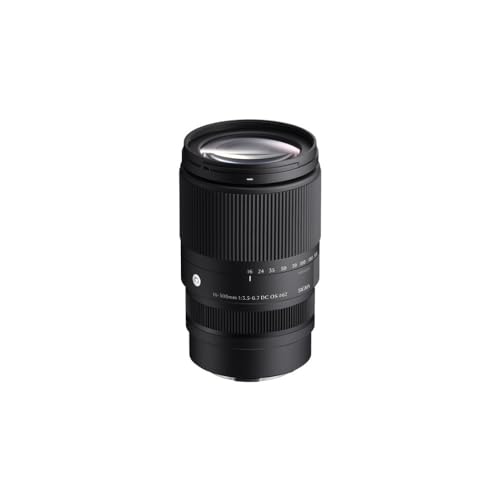
The Sigma 16-300mm F3.5-6.7 DC OS Contemporary is an expansive all-in-one zoom built for Canon RF mount APS-C bodies. With an 18.75:1 zoom ratio spanning from 16mm wide-angle to 300mm super-telephoto, it stands as an ultra-versatile solution for capturing everything from expansive landscapes to distant action. The autofocus system is powered by an HLA (High-response Linear Actuator) motor designed for fast, smooth, and accurate tracking. Macro capability is highlighted by a maximum magnification ratio of 1:2, allowing close-up captures of school projects, nature finds, and small keepsakes.
Durability for outdoor family travel is supported by a dust- and splash-resistant structure suited for harsh weather conditions, complemented by a front element treated with a water- and oil-repellent coating. Camera shake is countered by an optical stabilization system delivering 6 stops of correction at the wide end and 4.5 stops at the telephoto end. This stabilization is critical for keeping handheld shots sharp at 300mm, where the maximum aperture narrows to f/6.7. Those exploring comprehensive travel optics may also reference our sigma canon rf overview for additional brand insights.
This superzoom is the definitive selection for families who refuse to change lenses during beach vacations, camping trips, or stadium sports tournaments. Its vast focal envelope replaces multiple individual optics in a travel bag. Nevertheless, it trades away the bright, constant f/2.8 aperture found on the standard zoom models, meaning it requires higher camera ISO settings or daylight conditions when working indoors.
Also in this lineup
Sigma 18-50mm f 2.8 DC DN
The Sigma 18-50mm f 2.8 DC DN listing details an APS-C standard zoom configured for Fujifilm X mount mirrorless cameras, presented alongside an accessory bundle. The lens delivers a variable focal range of 18mm to 50mm, providing a full-frame field-of-view equivalence of approximately 27mm to 75mm. It maintains a constant f/2.8 bright maximum aperture across the entire zoom range, closing down to f/22 when deep depth of field is required. The design balances a compact form factor with durable materials built for long-term reliability in varying shooting environments.
Included with this package is a comprehensive accessory bundle consisting of a 3-piece filter kit, a 6-piece gradual filter set, a lens pen, a dust blower, and a starter cleaning kit. For busy households, these extras provide immediate maintenance tools to clean sticky fingerprints, dust, and moisture off exterior glass elements. The constant f/2.8 brightness allows family archivists to shoot at dinner tables or poorly lit school auditoriums without resorting to harsh pop-up flashes, while the dual AF/MF focus mode compatibility ensures flexible manual overrides when needed.
This package specifically targets users operating Fujifilm bodies who want a complete starter kit straight out of the box. While photographers considering ultra-compact primes can review our fujifilm pancake lens write-up, this zoom provides standard focal adaptability that primes cannot match. It yields to the wider 16-28mm options when the photographic goal centers strictly on wide-angle room interiors or sweeping scenic vistas.

Model 05 of 05
Sigma 16-28 mm F2.8 DG DN
Average rating left by Amazon buyers Mostly positive
What the listing highlights
- Sony E-Mount Lens/Full-Frame Format
- Aperture Range f/2.8 to f/22
- Five FLD Elements
What to check on the listing
- No Prime badge on this listing.
- Sold by RAD Savings; the listing does not show Amazon fulfilment.
Both columns are read from the Amazon product page. Nothing here comes from hands-on use.
Best for Expansive indoor gatherings and landscape outings
Pros
- Constant f/2.8 aperture throughout
- Inner zoom maintains balance
- Dust and splash resistant mount
Cons
- Limited reach at 28mm
The Sigma 16-28 mm F2.8 DG DN is a wide-angle zoom built for Sony E-mount systems, featuring full-frame sensor coverage. Its advanced optical path incorporates five FLD glass elements and four aspherical elements to control aberrations across an 83.2-degree real angle of view. The front and internal elements utilize Super Multi-Layer and Nano Porous Coatings to eliminate ghosting and flare when shooting toward bright light sources, such as sunny windows or outdoor stadium floodlights.
Mechanical construction highlights an inner zoom mechanism, ensuring the physical barrel length remains static during focal adjustments. This internal design maintains steady balance in the hands and minimizes the intake of dust or moisture into the moving barrels. The mount features a dust- and splash-resistant structure, while the body uses Thermally Stable Composite (TSC) material for structural stability across temperature changes. Autofocus is managed by a responsive, near-silent stepping motor, while a rounded 9-blade diaphragm produces smooth out-of-focus background elements.
This wide zoom is optimal for family gatherings held in compact living spaces, milestone holiday dinners around crowded tables, or landscape excursions where standard lenses feel overly restricted. Its full-frame compatibility also provides forward versatility if your household eventually transitions from an APS-C NEX camera to a larger full-frame body. However, with its zoom topping out at 28mm, it gives way to the 18-50mm Contemporary zoom when closer portraits of individual children are desired.
Matching a Model to Your Setup
- Busy parents needing an ultra-light everyday walkaround optic for Sony mirrorless bodies should pick the Sigma 18-50mm F2.8 DC DN Contemporary.
- Photographers who want an uncomplicated, lightweight wide-angle prime with optical stabilization should choose the Sigma 19mm F2.8 EX DN Art.
- Families traveling to theme parks, zoos, and sports fields requiring extreme zoom reach should select the Sigma 16-300mm F3.5-6.7 DC OS Contemporary.
- Fujifilm camera users who want an all-inclusive standard zoom bundle with protective filters and cleaning tools should choose the Sigma 18-50mm f 2.8 DC DN.
- Shooters documenting large group gatherings, tight home interiors, or sweeping vacation landscapes should opt for the Sigma 16-28 mm F2.8 DG DN.
Before You Buy
Before purchasing any lens from this collection, verify your camera body’s exact physical mount and sensor size. These listings encompass three distinct lens bayonets: Sony E, Canon RF, and Fujifilm X. Attaching a Canon RF or Fujifilm X lens to a Sony NEX body is mechanically impossible without specialized hardware that may compromise autofocus performance. Furthermore, while full-frame optics like the 16-28mm mount directly onto crop-sensor Sony bodies, APS-C lenses mounted to full-frame bodies trigger an automatic crop mode that reduces overall image resolution.
It is also important to note features that the product listings do not specify or include. The listings for the standard zoom models do not clarify whether bayonet lens hoods or soft protective storage pouches are included in the standard retail packages, nor do all listings specify complete dust-sealing gaskets around the outer barrel rings. Shooters operating older camera bodies without in-body image stabilization must also account for whether optical stabilization is built into the lens barrel, as models lacking this feature require higher shutter speeds to prevent motion blur during handheld indoor photography.
FAQ
Can I mount a Canon RF or Fujifilm X lens directly onto a Sony NEX camera?
No, you cannot mount them directly. Each camera system uses a proprietary bayonet design with distinct mechanical flanges and electronic contact pins. You must choose a model built specifically for Sony E-mount to achieve native communication and autofocus on Sony NEX or alpha bodies.
What does a constant f/2.8 aperture provide for family photography?
A constant f/2.8 aperture ensures the lens allows the same maximum amount of light into the sensor across all focal lengths. This consistency prevents the exposure from darkening when you zoom in on a subject, making it easier to capture sharp photos of active children in dimly lit rooms.
What is the advantage of an internal zoom design?
An internal zoom design, found on models like the 16-28mm, keeps the outer physical barrel the exact same length while zooming. This design preserves the physical balance of your camera setup and reduces the risk of drawing dust, dirt, or accidental spills into the internal barrel mechanisms during active family outings.
Why does the 16-300mm superzoom feature a variable aperture?
Covering an 18.8x zoom range from wide-angle to 300mm requires significant optical compromises to keep the lens portable. A variable aperture of f/3.5 to f/6.7 allows the lens barrel to remain compact and manageable for travel, though it requires stronger ambient light when zoomed all the way to 300mm.
Do these lenses feature built-in optical image stabilization?
Stabilization varies depending on the specific model. The 19mm Art listing notes optical stabilization, the 16-300mm Contemporary includes up to 6 stops of optical stabilization, and the 16-28mm lists optical stabilization in its specifications. Conversely, the 18-50mm Contemporary listing for Sony E specifically notes that image stabilization is not present.