DJI vs GXTDL Camera Drones: Which Brand Fits You?
Inspect ultralight aircraft from DJI and GXTDL using published specifications. Evaluate mechanical stabilization, screen controllers, and tracking modes to find the drone matching your flight profile.
As Amazon Associates, we earn from qualifying purchases. This means we may receive a small commission at no extra cost to you if you click through and make a purchase.
As an Amazon Associate we earn from qualifying purchases. Links on this page are affiliate links.
When evaluating a DJI vs GXTDL camera drone, you compare two distinct approaches to sub-249-gram flight. Both drones fall into the ultralight category, exempting recreational pilots from FAA registration. Both provide multi-battery kits yielding around 90 minutes of total air time. The primary differences lie in camera hardware, safety tech, and range. DJI features a mechanical 3-axis gimbal with 10-kilometer transmission. GXTDL provides 360-degree obstacle avoidance and an integrated controller screen.
Stabilization
3-axis mechanical gimbal
not listed
Transmission range
Up to 10 km (32,800 ft)
Up to 3 km (9,842 ft)
Obstacle sensing
not listed
360° omnidirectional sensing
Remote controller display
not listed
Integrated HD screen
Video resolution
4K Ultra HD
8K (also listed as 4K)
Choose the first if
- You prioritize stabilized video, as the 3-axis mechanical gimbal dampens flight vibrations.
- You require extended transmission coverage up to 10 kilometers.
- You want automated cinematic flight paths using QuickShots like Dronie, Helix, and Circle.
Choose the second if
- You want 360-degree obstacle avoidance sensors for automated barrier detection.
- You prefer a remote control with an integrated screen over mounting a phone.
- You plan to use GPS flight modes like Follow Me and Waypoint navigation.
Verdict
Choose DJI if you require mechanical gimbal stabilization and extended 10 km transmission range for cleaner aerial footage. Select GXTDL if you want built-in 360-degree obstacle sensing and an integrated display screen on the transmitter. Both options keep takeoff weight under 249 grams to avoid registration requirements.
DJI vs GXTDL Drone Comparison
Camera Stabilization
Edge: DJI Mini 4K Fly More Combo
When choosing between the DJI Mini 4K Fly More Combo and the GXTDL Ultralight Drone with Screen Controller, camera stability is a critical factor. The DJI Mini 4K integrates a mechanical 3-axis gimbal to stabilize footage across pitch, roll, and yaw during flight. This hardware system keeps your 4K Ultra HD video steady even when the aircraft moves in active conditions. In contrast, the GXTDL drone features an 8K camera with a 90-degree adjustable and 120-degree wide-angle lens, but its specifications do not list a motorized gimbal stabilization system. For mechanical video smoothing, DJI holds the advantage.
Obstacle Sensing
Edge: GXTDL Ultralight Drone with Screen Controller
Obstacle detection helps prevent collisions, especially when you navigate tight spaces. The GXTDL Ultralight Drone with Screen Controller includes built-in 360-degree all-round obstacle avoidance designed to automatically detect and avoid barriers during indoor and outdoor flying. This omnidirectional system adds an extra protective layer for beginner pilots navigating around trees or structures. On the other hand, the DJI Mini 4K Fly More Combo does not feature obstacle sensing hardware or avoidance sensors in its published specifications. If you prioritize automated barrier detection to help prevent accidental crashes while operating close to objects, GXTDL delivers the built-in coverage.
Transmission Range
Edge: DJI Mini 4K Fly More Combo
Video transmission distance determines how far you can pilot while maintaining a reliable live feed. The DJI Mini 4K Fly More Combo offers up to 10 kilometers (32,800 feet) of HD video transmission, supported by anti-interference technology to maintain a clear picture across expansive areas. By comparison, the GXTDL Ultralight Drone with Screen Controller operates over 5GHz FPV / 5G Wi-Fi, offering a maximum remote control and video range of up to 9,842 feet (3 kilometers). With more than triple the operating reach on paper, DJI provides a significantly broader operational envelope for long-distance aerial exploration.
Controller Display Configuration
Edge: GXTDL Ultralight Drone with Screen Controller
Your controller setup influences how quickly you can launch and monitor flights. The GXTDL Ultralight Drone with Screen Controller comes equipped with a dedicated remote featuring an integrated 5-inch HD display (also listed as 4.5 inches), enabling standalone FPV viewing directly from the handheld unit without mounting your phone. Conversely, the DJI Mini 4K Fly More Combo relies on a standard remote that requires connecting a separate smartphone. You must also download the DJI Fly app directly from DJI’s website due to Google Play compatibility. For an all-in-one handheld viewing setup, GXTDL provides the more direct solution.
Wind Resistance and Altitude
Edge: DJI Mini 4K Fly More Combo
Flight stability in breezy environments depends on motor capability and structural engineering. The DJI Mini 4K Fly More Combo lists Level 5 wind resistance, enabling it to withstand winds up to 38 kilometers per hour, alongside brushless motors capable of taking off at altitudes up to 4,000 meters. The GXTDL Ultralight Drone with Screen Controller also uses upgraded brushless motors to handle breezy conditions with lower noise and power draw, but its specifications do not provide a rated wind speed scale or a maximum takeoff altitude figure. DJI offers quantified performance limits for flying in brisk outdoor breezes.
Smart Flight Features
Edge: Tie
Both drones provide automated flight options to simplify aerial maneuvers. The DJI Mini 4K Fly More Combo includes GPS Return to Home, stable hovering, and QuickShots such as Helix, Dronie, Rocket, Circle, and Boomerang. Meanwhile, the GXTDL Ultralight Drone with Screen Controller incorporates GPS auto-return for low battery or signal loss, alongside Follow-Me, Waypoint, Circle-Fly, and headless mode, with some functions accessible via a connected mobile app. While DJI focuses on pre-programmed automated cinematic camera moves, GXTDL supplies tracking and route-planning options. Because each drone offers distinct automated modes suited to different flight routines, this round is a tie.
Choosing Your Ideal Camera Drone
Pilots needing extended transmission range and wind resistance
Our pick: DJI Mini 4K Fly More Combo
If you plan to fly across wide distances, choose this model. You get up to 10 kilometers of HD video transmission to explore vast areas reliably. Its brushless motors deliver Level 5 wind resistance against 38 kph gusts, and it supports takeoff at altitudes reaching 4,000 meters.
Flyers seeking built-in monitors and obstacle detection
Our pick: GXTDL Ultralight Drone with Screen Controller
Select this option if you want direct visual monitoring without connecting your smartphone. The included remote control integrates a 5-inch HD display for real-time FPV viewing across 9,842 feet. You also receive 360-degree obstacle avoidance that detects barriers automatically to keep your flights safe indoors or outside.
Creators wanting automated pre-programmed flight patterns
Our pick: DJI Mini 4K Fly More Combo
Choose this drone if you want automated cinematic flight paths without manual piloting. It includes Intelligent QuickShots such as Helix, Dronie, Rocket, Circle, and Boomerang modes to capture dynamic angles automatically. You also get GPS Return to Home, stable hovering, and one-tap takeoff to streamline basic operations.

DJI Mini 4K Fly More Combo
Best for: recreational pilots wanting lightweight stabilized 4K video
- Video Resolution
- 4K UHD
- Takeoff Weight
- Under 249 g
- Flight Time
- 31-min (93-min with 3 batteries)
- Gimbal Stabilization
- 3-Axis
- Transmission Range
- 10 km (32,800 feet)
- Weight Class
- Under 249g
The DJI Mini 4K Camera Drone is an ultralight quadcopter weighing under 249 grams. It features a 4K camera stabilized by a 3-axis gimbal, 10-kilometer HD video transmission, and Level 5 wind resistance. Each battery provides 31 minutes of flight, totaling up to 93 minutes with this combo. It suits you if you want stabilized footage without FAA registration.
- Under 249 g takeoff weight requires no recreational FAA registration
- 3-axis mechanical gimbal stabilization for 4K video
- Up to 10 km HD video transmission range
- Level 5 wind resistance up to 38 kph
- DJI Fly app requires direct download from DJI website rather than Google Play
- Video resolution tops out at 4K rather than 8K
- You want a sub-249 g drone to bypass recreational FAA registration
- You need 3-axis mechanical gimbal stabilization for smooth video
- You plan to fly long distances up to 10 kilometers
- You require standard app installation through the Google Play store
- You want camera resolutions beyond 4K
Verdict: DJI Mini 4K Camera Drone fits pilots who need stabilized 4K recording and up to 10 kilometers of transmission range in an ultralight frame. It delivers extended airtime across three batteries without recreational registration hurdles.
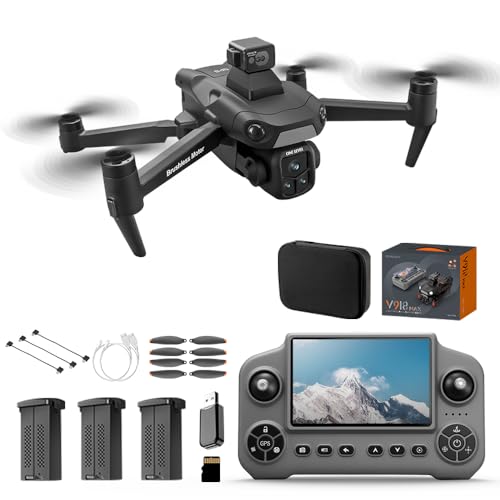
GXTDL Ultralight Drone with Screen Controller
Best for: sub-249g flights with an integrated controller screen
- Video Resolution
- 8K
- Takeoff Weight
- Under 249g
- Flight Time
- 90 Mins
- Obstacle Sensing
- 360°
- Transmission Range
- 3KM
- Smart Features
- Auto Return, Follow Me
This folding quadcopter weighs under 249 grams, removing the requirement for registration before you fly. It includes three 3,000 mAh batteries for up to 90 minutes of total flight time, 360-degree obstacle avoidance, and a remote controller with an integrated screen. It suits beginners seeking built-in display controls, extended battery supplies, and automated GPS return without adding mobile devices.
- Weighs under 249 grams to avoid registration requirements
- Built-in 360-degree obstacle avoidance sensor
- Three batteries provide up to 90 minutes of combined flight time
- Remote controller features an integrated display
- Includes memory card, reader, and storage case
- Requires connecting a smartphone to unlock advanced camera features
- Requires acquisition of at least 9 satellites before takeoff for reliable return-to-home
- You want a controller with a built-in screen instead of mounting a phone.
- You need extended airtime across three included battery packs.
- You want omnidirectional obstacle sensing on an ultralight drone.
- You want every camera mode accessible directly on the remote without a mobile app.
- You frequently fly in indoor or obstructed areas with weak GPS satellite reception.
Verdict: GXTDL Foldable GPS Drone with Display provides an all-in-one setup with three batteries, obstacle detection, and a dedicated monitor under the 249-gram limit. It fits pilots who want ready-to-fly hardware with long operational endurance right out of the box.
Specifications side by side
| Spec | DJI Mini 4K Fly More Combo | GXTDL Ultralight Drone with Screen Controller |
|---|---|---|
| Video Resolution | 4K UHD | 8K |
| Takeoff Weight | Under 249 g | Under 249g |
| Flight Time | 31-min (93-min with 3 batteries) | 90 Mins |
| Obstacle Sensing | – | 360° |
| Gimbal Stabilization | 3-Axis | – |
| Transmission Range | 10 km (32,800 feet) | 3KM |
| Stabilization | 3-Axis Gimbal | – |
| Weight Class | Under 249g | – |
| Smart Features | Auto Return | Auto Return, Follow Me |
| Target Audience | – | Beginners |
| Features | Stabilization | GPS |
| Dimensions | 9.65 × 11.4 × 2.2 inches | 9.84 × 3.93 × 12.2 inches |
| Weight | 8.47 ounces | 3.1 pounds |
| Color | gray | Black-3B |
| Model | RC231 | – |
Frequently asked questions
Which drone offers autonomous tracking features?
The GXTDL Ultralight Drone includes autonomous tracking through its built-in Follow Me mode. DJI Mini 4K does not list autonomous subject tracking among its smart capabilities, focusing instead on manual control and Auto Return. If you want hands-free tracking during outdoor activities, the GXTDL model provides that specific flight mode.
What is the transmission range difference between DJI and GXTDL?
The DJI Mini 4K specifies a transmission range reaching up to 10 kilometers. GXTDL does not publish a verified maximum transmission distance in its specifications. If you plan to fly across wide open spaces, the documented 10-kilometer link on the DJI drone gives you a verified operating boundary for continuous control.
Do both DJI and GXTDL drones record in 4K resolution?
Yes, both models support 4K video recording. The DJI Mini 4K pairs its 4K camera with a mechanical 3-axis gimbal for motorized image stabilization. GXTDL also records 4K video, but its hardware relies on omnidirectional obstacle sensing to assist your flights rather than a specified 3-axis mechanical gimbal system.
Which drone provides obstacle detection sensors?
The GXTDL drone includes omnidirectional obstacle sensing to detect barriers around the aircraft. The DJI Mini 4K specifications do not include omnidirectional obstacle sensors. If you are a beginner who wants automated environmental detection to help prevent collisions during low-altitude flights, the GXTDL platform integrates that safety feature directly into its body.
What kind of controller display comes with each brand?
GXTDL includes a screen controller featuring an integrated display monitor right out of the box. DJI Mini 4K Fly More Combo utilizes a standard controller that connects to your smartphone screen to view telemetry. Choosing GXTDL lets you fly without mounting your phone, while DJI depends on your mobile device.
Do both drones have automated return home functions?
Yes, both models feature Auto Return capabilities to bring the aircraft back automatically. The GXTDL drone utilizes an integrated GPS system to navigate back safely, while the DJI Mini 4K also incorporates Auto Return into its smart features. You get emergency failsafe return on both aircraft if a signal connection drops.


