Best Camera Drones Under $3000: 8 Spec-Based Picks
Review 8 camera drones evaluated through published specifications. Compare 4/3 CMOS sensors, multi-lens setups, and flight endurance to select the right platform for your aerial projects.
As Amazon Associates, we earn from qualifying purchases. This means we may receive a small commission at no extra cost to you if you click through and make a purchase.
As an Amazon Associate we earn from qualifying purchases. Links on this page are affiliate links.
Finding the best camera drones under $3000 requires comparing imaging sensors, camera configurations, and battery endurance. We compared 8 models using the specifications published on their listings.
The DJI Mavic 4 Pro Tri-Camera Drone leads because its 4/3 CMOS triple-camera setup and 51-minute flight sessions support 6K video and 100MP stills. This guide helps you decide which platform best matches your requirements for sensor size, multi-lens hardware, and total flight duration.
Sensor Hardware Defines Your Drone Workflow
Your workload determines whether you need optical versatility or specialized positioning. The Autel EVO II Pro RTK V3 targets centimeter-accurate surveying using a 6K imaging setup. Meanwhile, the DJI Mavic 3 Pro uses a 4/3 CMOS triple-camera system for framing across multiple focal lengths.
| # | Product | Best for | Price |
|---|---|---|---|
| 1 | DJI Mavic 4 Pro Tri-Camera Drone Best overall | high-resolution aerial filmmaking and long flight times | |
| 2 | DJI Mavic 4 Pro Triple Camera Drone Best budget | long-endurance triple-camera aerial imaging | |
| 3 | Autel EVO II Pro RTK V3 Best premium | centimeter-accurate aerial mapping and surveying missions | |
| 4 | DJI Mavic 3 Pro Triple-Camera Drone Also great | multi-lens aerial imaging and extended flight sessions | |
| 5 | DJI Mavic 4 Pro Triple-Camera Drone Also great | long-duration flights needing multiple optical focal lengths | |
| 6 | DJI Mavic 3 5.1K Camera Drone Best omnidirectional obstacle sensing | Long-flight 5.1K imaging with all-around obstacle avoidance | |
| 7 | Autel EVO II Pro RTK 6K Drone Also great | precision aerial surveying and mapping missions | |
| 8 | Autel EVO 2 Pro Enterprise Drone Best 1-inch cmos | Commercial inspection and night utility flights |
The best fit for you
- You need maximum flight endurance and 100MP photos – DJI Mavic 4 Pro Tri-Camera Drone – It provides a 51-minute flight time, 100MP stills, and a 4/3 CMOS triple camera.
- You need centimeter precision for mapping and surveying missions – Autel EVO II Pro RTK V3 – It provides centimeter-level positioning accuracy alongside 6K video resolution for surveying.
- You want omnidirectional obstacle sensing with 5.1K recording – DJI Mavic 3 5.1K Camera Drone – It features omnidirectional obstacle sensing, a 4/3 CMOS sensor, and 46 minutes of endurance.
- You require dedicated payloads for industrial inspection flights – Autel EVO 2 Pro Enterprise Drone – It supports dedicated work payloads with a 1-inch CMOS sensor and 42 minutes of flight time.
Hardware Trade-Offs Under $3000
Drones Under $3000 balance commercial imaging and flight times, but you accept hardware boundaries. Video resolution tops out at 6K, with sensors capped at 4/3 CMOS and 1-inch CMOS sizes. You will not find larger sensor formats in this group. Weight class also stays heavy, ranging from 1.97 pounds to 9.31 pounds. Additionally, single-lens configurations on mapping models lack the multi-camera framing options found on dedicated aerial imaging builds.
- Sensor size tops out at 4/3 CMOS and 1-inch CMOS formats
- Video resolution caps at 6K capture
- Airframe weight spans from 1.97 pounds up to 9.31 pounds

DJI Mavic 4 Pro Tri-Camera Drone
Best for: high-resolution aerial filmmaking and long flight times
- Video Resolution
- 6K
- Sensor Size
- 4/3 CMOS
- Flight Time
- 51 minutes
- Obstacle Sensing
- Omnidirectional
- Gimbal Stabilization
- 360° Infinity Gimbal
- Transmission Range
- 30km/18.6mi
The DJI Mavic 4 Pro Triple-Camera Drone combines a 100MP 4/3 CMOS main sensor with dual telephoto cameras and a 360° Infinity Gimbal. It records video up to 6K at 60fps and delivers up to 51 minutes of flight per battery. With 30km transmission range and omnidirectional night sensing, it gives you extended air time and cinematic multi-angle flexibility.
- 51-minute flight time per battery
- 100MP 4/3 CMOS Hasselblad camera with 6K/60fps HDR video
- 360° Infinity Gimbal for dynamic camera positioning
- 30km (18.6mi) O4+ 10-bit HDR video transmission
- 0.1-Lux Nightscape omnidirectional obstacle sensing
- Total kit weight reaches 9.31 pounds
- Lacks RTK centimeter-level positioning hardware
- You need up to 51 minutes of flight time from a single battery.
- You shoot 6K HDR footage and 100MP stills with multiple focal lengths.
- You require 360-degree gimbal rotation for dynamic aerial shots.
- You need centimeter-level RTK positioning for precision mapping.
- You want a pack weight lighter than nine pounds.
Verdict: DJI Mavic 4 Pro Triple-Camera Drone suits commercial creators who require 100MP stills, 6K video, and extended 51-minute flight sessions. Its 360-degree gimbal and triple-camera array provide versatile framing options for high-end aerial production.

DJI Mavic 4 Pro Triple Camera Drone
Best for: long-endurance triple-camera aerial imaging
- Video Resolution
- 6K/60fps HDR
- Sensor Size
- 4/3 CMOS
- Flight Time
- 51-minute
- Obstacle Sensing
- Omnidirectional
- Gimbal Stabilization
- Infinity Gimbal 360° Rotation
- Transmission Range
- 30km (18.6 mi)
This drone pairs a 100MP 4/3 CMOS main sensor with two telephoto lenses and 6K/60fps HDR video capture. It provides up to 51 minutes of flight time, 64GB of internal storage, and omnidirectional obstacle sensing guided by LiDAR and fisheye cameras. It gives you extended flight duration and multi-angle camera options for detailed aerial filming.
- 51-minute maximum flight time
- 100MP 4/3 CMOS sensor with 6K/60fps HDR video
- Omnidirectional obstacle sensing with six fisheye sensors and LiDAR
- Infinity Gimbal with 360-degree rotation
- Total weight of 2.11 pounds exceeds ultralight limits
- 64GB onboard storage fills quickly when shooting 100MP RAW files
- You want up to 51 minutes of flight time per charge.
- You need a triple-camera system with a 100MP main sensor.
- You require a sub-250-gram drone for minimal flight restrictions.
- You need integrated RTK hardware for centimeter-level mapping.
Verdict: DJI Mavic 4 Pro Triple-Camera Drone delivers 51-minute airtime and 100MP multi-lens imaging with 360-degree gimbal control. It matches aerial videographers who need extended endurance and obstacle avoidance in complex environments.
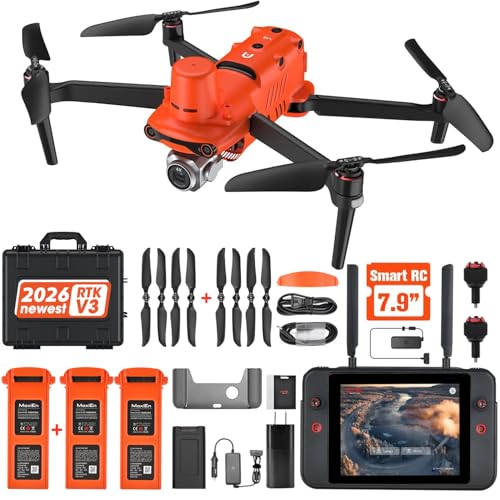
Autel EVO II Pro RTK V3
Best for: centimeter-accurate aerial mapping and surveying missions
- Video Resolution
- 6K/30fps HDR
- Sensor Size
- 1''
- Flight Time
- 38 min
- Transmission Range
- 15KM
- Dimensions
- 21 × 5.5 × 17.8 inches
You get an enterprise-grade surveying drone equipped with a 1-inch sensor recording up to 6K video at 30 fps. The integrated RTK module delivers real-time centimeter-level positioning accuracy alongside autonomous flight route planning for waypoint and oblique mapping. With a 38-minute flight time and a 15-kilometer transmission range, it suits you if you need precise aerial mapping and repeatable coordinates.
- Centimeter-level positioning accuracy via integrated RTK module
- 1-inch sensor recording 6K HDR video at 30 fps
- Up to 38 minutes of flight time
- 15-kilometer transmission range
- Video capture at 6K resolution is limited to 30 fps
- Autel Mapper software requires a Windows PC with an Nvidia graphics card
- You need real-time centimeter-level GNSS positioning without setting ground control points.
- You run automated mapping missions using waypoint, polygon, or oblique flight routes.
- You need 60 fps frame rates when recording at 6K resolution.
- You work on non-Windows computers or systems without dedicated Nvidia graphics hardware.
Verdict: Autel EVO II Pro RTK 6K Drone provides centimeter-level positioning accuracy and 6K imaging for operators executing photogrammetry, surveying, and autonomous mapping flights.
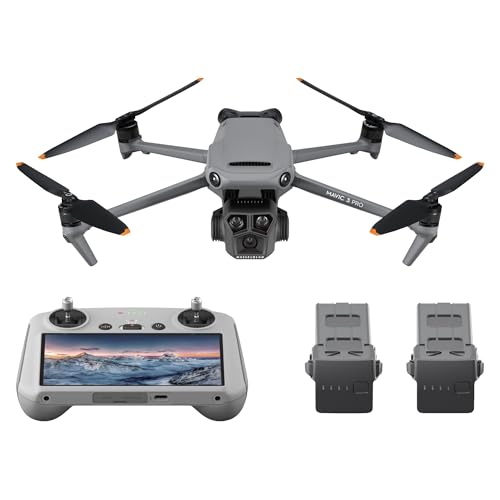
DJI Mavic 3 Pro Triple-Camera Drone
Best for: multi-lens aerial imaging and extended flight sessions
- Video Resolution
- 4K
- Sensor Size
- 4/3 CMOS
- Flight Time
- 43-minute
- Obstacle Sensing
- Omnidirectional
- Transmission Range
- up to 15 km
- Photo Resolution
- 20 MP
This drone package includes a triple-camera system paired with the DJI RC remote and three batteries. You get a primary 20 MP 4/3 CMOS Hasselblad camera that records 4K video, alongside an omnidirectional obstacle sensing system with eight vision sensors. With a maximum flight time of 43 minutes and a 15-kilometer transmission range, it suits aerial photographers seeking extended multi-focal coverage.
- 4/3 CMOS 20 MP Hasselblad main camera with adjustable f/2.8 to f/11 aperture
- Max flight time of up to 43 minutes per battery
- Omnidirectional obstacle sensing system powered by eight vision sensors and APAS 5.0
- O3+ video transmission range reaching up to 15 km
- Combo includes three flight batteries and a dedicated charging hub
- Photo resolution is limited to 20 MP
- Video capture tops out at 4K resolution
- Total airframe weight reaches 2.11 pounds
- You need multiple optical focal lengths, including a 24mm wide and 70mm telephoto camera.
- You want long operating sessions supported by three batteries providing up to 43 minutes each.
- You require all-around obstacle awareness using eight vision sensors.
- You require photo resolutions higher than 20 MP.
- You need an aircraft lighter than 2.11 pounds.
Verdict: DJI Mavic 3 Pro Triple-Camera Drone provides aerial imaging operators with a flexible multi-lens setup and 43 minutes of airtime per pack. It fits creators who need optical versatility and 15 km transmission stability for extended field production.
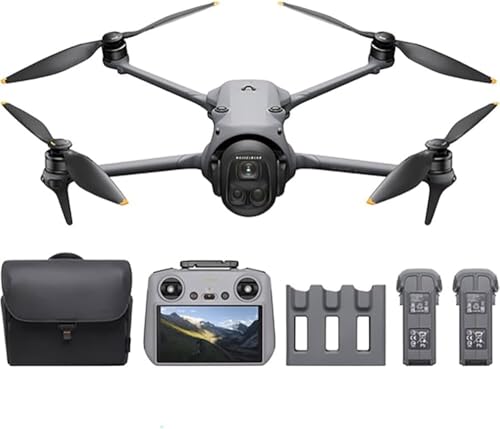
DJI Mavic 4 Pro Triple-Camera Drone
Best for: long-duration flights needing multiple optical focal lengths
- Video Resolution
- 6K/60fps HDR
- Sensor Size
- 4/3 CMOS
- Flight Time
- 51-Minute
- Obstacle Sensing
- Omnidirectional
- Gimbal Stabilization
- Infinity Gimbal 360° Rotation
- Transmission Range
- 30 km
This drone features a triple-camera imaging array centered on a 4/3 CMOS 100MP Hasselblad sensor that captures 6K video at 60 frames per second. It integrates dual telephoto cameras, a 360-degree rotating gimbal, and omnidirectional LiDAR obstacle sensing. Offering up to 51 minutes of flight time, it suits you if you need extended airtime and multiple focal lengths.
- 100MP 4/3 CMOS main sensor records up to 6K at 60fps HDR
- 51-minute maximum flight time with a 95Wh battery
- Omnidirectional LiDAR sensing rated down to 0.1 lux
- Dual telephoto cameras with 48MP and 50MP sensors
- DJI O4+ video transmission range reaching up to 30 km
- Carries a 2.11-pound overall weight
- Telephoto cameras use smaller sensors than the primary 4/3 CMOS unit
- You need long endurance up to 51 minutes per battery charge.
- You capture aerial footage in low light using LiDAR obstacle sensing.
- You want triple focal lengths without swapping lenses in flight.
- You need an ultralight drone weighing under 249 grams.
- You prefer a compact airframe smaller than 13.7 inches in length.
Verdict: DJI Mavic 4 Pro Triple Camera Drone delivers 6K video, 51-minute endurance, and three dedicated camera sensors for filmmakers who prioritize optical versatility over lightweight portability.

DJI Mavic 3 5.1K Camera Drone
Best for: Long-flight 5.1K imaging with all-around obstacle avoidance
- Video Resolution
- 5.1K
- Sensor Size
- 4/3 CMOS
- Flight Time
- 46 minutes
- Obstacle Sensing
- Omnidirectional
- Transmission Range
- 15-kilometer
- Smart Features
- Auto Return
The DJI Mavic 3 5.1K Camera Drone is a folding quadcopter built around a 4/3 CMOS Hasselblad sensor capturing 5.1K video. It delivers up to 46 minutes of flight time, omnidirectional obstacle sensing, and a 15-kilometer transmission range using O3 plus. You get an Advanced RTH system, making this platform ideal if you prioritize extended airtime and all-around obstacle detection.
- 4/3 CMOS Hasselblad sensor with 5.1K video recording
- Up to 46 minutes of flight time per charge
- Omnidirectional obstacle sensing system
- 15-kilometer O3 plus transmission range
- Single-camera configuration lacks dedicated telephoto lenses
- No centimeter-level RTK positioning hardware
- You need omnidirectional obstacle detection for safer navigation.
- You want up to 46 minutes of flight time per battery.
- You record footage in 5.1K resolution using a 4/3 CMOS sensor.
- You require a multi-camera or triple-lens configuration.
- You need specialized RTK centimeter-level positioning gear.
Verdict: DJI Mavic 3 5.1K Camera Drone provides 46 minutes of endurance and omnidirectional sensing for solo pilots shooting high-resolution 5.1K footage without multi-lens hardware.

Autel EVO II Pro RTK 6K Drone
Best for: precision aerial surveying and mapping missions
- Video Resolution
- 6K
- Sensor Size
- 1-inch
- Obstacle Sensing
- 360°
- Transmission Range
- 15KM
- Photo Resolution
- 20MP
- Dimensions
- 9 × 5 × 5.6 inches
This drone combines a 1-inch sensor camera with a real-time kinematic module for centimeter-level mapping accuracy. You get 6K video at 30 frames per second, 20MP stills, and an adjustable f/2.8 to f/11 aperture. With 360-degree obstacle sensing and an included 7.9-inch 2000-nit smart controller, it suits site surveying, agriculture, and precision photogrammetry.
- RTK module delivers centimeter-level horizontal and vertical positioning accuracy
- 1-inch sensor captures 20MP photos and 6K video with an adjustable f/2.8 to f/11 aperture
- Smart controller includes a 7.9-inch 2000-nit screen and IP43 weather resistance
- Omnidirectional 360-degree obstacle avoidance using 19 sensor groups
- 6K video capture is limited to 30 frames per second
- Single-camera layout lacks dedicated optical telephoto lenses
- You need centimeter-accurate RTK positioning data for surveying or mapping missions.
- You operate outdoors in direct sunlight and need a 2000-nit built-in controller display.
- You require an adjustable f/2.8 to f/11 physical aperture for exposure control.
- You want high-frame-rate 6K recording beyond 30 frames per second.
- You need multiple focal lengths from a multi-camera array.
Verdict: Autel EVO II Pro RTK Camera Drone pairs centimeter-level survey positioning with a 1-inch 6K imaging system for operators who require precise spatial data. The included 2000-nit controller and three batteries provide a complete mapping deployment straight from the case.

Autel EVO 2 Pro Enterprise Drone
Best for: Commercial inspection and night utility flights
- Video Resolution
- 6K/30fps
- Sensor Size
- 1" CMOS
- Flight Time
- 42 minutes
- Transmission Range
- 15 KM
- Photo Resolution
- 20MP
- Dimensions
- 4.3 × 9 × 5 inches
The Autel EVO II Pro Enterprise Drone is an aerial platform built around a 1-inch CMOS sensor. You get 20MP stills, 6K video at 30 fps, and an adjustable f/2.8 to f/11 aperture. With a 42-minute flight time and modular enterprise accessories including a spotlight and loudspeaker, it suits commercial operators who need flexible low-light imaging.
- 1-inch CMOS sensor capturing 20MP photos and 6K video at 30 fps
- Flight time rated up to 42 minutes
- Adjustable f/2.8 to f/11 aperture range with maximum ISO of 44000
- Includes modular spotlight, loudspeaker, and strobe attachments
- 6K video capture is limited to 30 fps
- Total weight of 2.45 pounds makes it bulkier than standard folding drones
- You need a 1-inch sensor paired with an adjustable aperture for exposure control
- You require utility payloads such as a loudspeaker, spotlight, or strobe
- You want flight endurance up to 42 minutes per battery
- You require frame rates above 30 fps when shooting in 6K resolution
- You want a lightweight airframe weighing under two pounds
Verdict: Autel EVO II Pro Enterprise Drone delivers 6K recording, a 1-inch CMOS sensor, and 42 minutes of flight time with dedicated work payloads. It provides industrial inspection and night utility features for operators who do not require high-frame-rate video.
Specifications side by side
| Spec | DJI Mavic 4 Pro Tri-Camera Drone | DJI Mavic 4 Pro Triple Camera Drone | Autel EVO II Pro RTK V3 | DJI Mavic 3 Pro Triple-Camera Drone | DJI Mavic 4 Pro Triple-Camera Drone | DJI Mavic 3 5.1K Camera Drone | Autel EVO II Pro RTK 6K Drone | Autel EVO 2 Pro Enterprise Drone |
|---|---|---|---|---|---|---|---|---|
| Video Resolution | 6K | 6K/60fps HDR | 6K/30fps HDR | 4K | 6K/60fps HDR | 5.1K | 6K | 6K/30fps |
| Sensor Size | 4/3 CMOS | 4/3 CMOS | 1'' | 4/3 CMOS | 4/3 CMOS | 4/3 CMOS | 1-inch | 1" CMOS |
| Flight Time | 51 minutes | 51-minute | 38 min | 43-minute | 51-Minute | 46 minutes | – | 42 minutes |
| Obstacle Sensing | Omnidirectional | Omnidirectional | – | Omnidirectional | Omnidirectional | Omnidirectional | 360° | – |
| Gimbal Stabilization | 360° Infinity Gimbal | Infinity Gimbal 360° Rotation | – | – | Infinity Gimbal 360° Rotation | – | – | – |
| Transmission Range | 30km/18.6mi | 30km (18.6 mi) | 15KM | up to 15 km | 30 km | 15-kilometer | 15KM | 15 KM |
| Photo Resolution | 100MP | 100MP | – | 20 MP | 100MP | – | 20MP | 20MP |
| Camera Configuration | Triple Camera | Triple Camera | – | Triple Camera | Triple Camera | – | – | – |
| Smart Features | – | – | – | – | – | Auto Return | – | – |
| Dimensions | 12.9 × 15.4 × 5.32 inches | 13.7 × 11.4 × 4.24 inches | 21 × 5.5 × 17.8 inches | 13.7 × 11.4 × 4.25 inches | 13.7 × 11.4 × 4.24 inches | 11 × 7.05 × 13.9 inches | 9 × 5 × 5.6 inches | 4.3 × 9 × 5 inches |
| Weight | 9.31 pounds | 2.11 pounds | – | 2.11 pounds | 2.11 pounds | 1.97 pounds | – | 2.45 pounds |
| Size | 7.25 | 34.73 cm x 29.05 cm x 10.77 cm | – | – | – | DJI Mavic 3 Fly More Combo | – | – |
| Color | Gray | Grey | Orange | black | black | Gray | orange | Autel Orange |
| Model | 6937224109940 | – | – | 6941565957092 | CP.MA.00000848.01 | 6941565919694 | – | – |
If you prioritize sensor size over aerial mobility, evaluate specifications for the best mirrorless cameras under 3000 instead.
How We Selected These Drones
You see camera drones selected from listings matching Under $3000. We evaluate published technical specifications and feature lists without physical handling. To keep comparisons clear, only one variant per product family appears. Products are ordered with products in stock first, then by Amazon sales rank.
Catalog details and availability refresh daily on the page. Drones qualify for this guide strictly while fitting Under $3000, so models move in or out as market listings change. This approach gives you a practical overview based entirely on published manufacturer data.
How to Choose a Camera Drone
Evaluating Camera Configurations
Check whether a drone uses a single lens or a multi-lens camera module. Triple-camera options let you switch between different optical perspectives without landing to swap lenses. This setup benefits cinematographers who need instant framing flexibility during live shoots. Solo operators capturing broad landscapes can manage well with single primary lenses. Models like the DJI Mavic 3 Pro offer a triple-camera system to provide multiple focal lengths from one airborne position.
Checking Obstacle Sensing Systems
Look at the obstacle detection coverage before choosing an airframe. Omnidirectional sensing monitors hazards in all directions around the aircraft, helping protect the drone during complex automated tracking or low-altitude maneuvers. Pilots navigating tight outdoor spaces or wooded areas benefit most from comprehensive spatial awareness. If you plan only open-sky flights at high altitudes, basic directional monitoring may meet your requirements. The DJI Mavic 3 5.1K Camera Drone features omnidirectional obstacle sensing to assist navigation.
Comparing Native Video Resolutions
Review the maximum video resolution listed in the camera specifications. Recording at 6K provides substantial visual detail and allows you to crop or stabilize footage in post-production without dropping below ultra-high-definition output standards. Content producers delivering strictly for standard streaming can work efficiently with 5.1K recording. Choose higher native capture resolution if your projects require fine image detail for large commercial displays. The Autel EVO 2 Pro Enterprise Drone specifies 6K video recording for commercial operations.
Examining Airframe Total Weight
Check the published aircraft weight before committing to a system. Airframes weighing close to 2 pounds pack down easily into backpacks, suiting mobile teams who hike to flight locations. Heavier drones over 9 pounds require dedicated transport cases and may face stricter local flight regulations or operating restrictions. If rapid field deployment is your priority, select a lighter airframe. The DJI Mavic 4 Pro Triple Camera Drone lists a weight of 2.11 pounds for easier transport.
Selecting the Sensor Size
Compare the physical dimensions of the camera image sensor. A 4/3 CMOS sensor provides greater surface area to gather light, which helps reduce visual noise during dawn, dusk, or night flights. A 1-inch CMOS sensor offers a balanced profile for daylight mapping and general aerial imaging where extreme low-light performance is less critical. Match the sensor size to your typical lighting conditions. The DJI Mavic 4 Pro Tri-Camera Drone includes a 4/3 CMOS sensor.
Frequently asked questions
Which camera drones support 6K video recording?
Several models provide native 6K video capture. You can record 6K footage with the DJI Mavic 4 Pro Triple Camera Drone, the Autel EVO II Pro RTK V3, and the Autel EVO 2 Pro Enterprise Drone. These platforms capture high-resolution aerial footage for commercial video projects and technical inspections.
What is the longest flight time among these camera drones?
The longest flight time is 51 minutes. You achieve this endurance with the DJI Mavic 4 Pro Tri-Camera Drone. Other models deliver flight durations between 42 and 46 minutes, such as the Autel EVO 2 Pro Enterprise Drone at 42 minutes and the DJI Mavic 3 at 46 minutes.
Which camera drones include RTK positioning modules?
Both the Autel EVO II Pro RTK V3 and the Autel EVO II Pro RTK 6K Drone feature dedicated RTK hardware. This system gives you centimeter-level positioning accuracy. You use this capability for autonomous photogrammetry, accurate land surveying, and repeatable mapping missions requiring precise geographic coordinates.
What video transmission distance do Mavic drones provide?
The DJI Mavic 3 Pro provides up to 15 kilometers of transmission stability. This range helps you maintain a clear video feed during long-distance flights and complex shoots. Reliable transmission ensures you keep continuous control and real-time visual monitoring over your camera frame throughout extended production flights.
Which drones include automated return to home functions?
The DJI Mavic 3 5.1K Camera Drone features an Auto Return smart feature alongside omnidirectional obstacle sensing. When triggered, the drone navigates back automatically to the launch point. This hardware configuration helps you safeguard the aircraft from obstacles during autonomous return sequences in varied terrain.
What still photo resolutions do 1-inch sensor drones produce?
Drones equipped with a 1-inch CMOS sensor, such as the Autel EVO II Pro RTK 6K Drone and the Autel EVO 2 Pro Enterprise Drone, capture 20MP photos. This resolution provides detailed still imagery suitable for industrial asset inspection, site analysis, and professional mapping documentation.
What do folding camera drones in this category weigh?
Weights for folding models in this class generally span between 1.97 and 2.45 pounds. The DJI Mavic 3 weighs 1.97 pounds, while models like the DJI Mavic 3 Pro weigh 2.11 pounds. The Autel EVO 2 Pro Enterprise Drone weighs 2.45 pounds with its payload capabilities.


