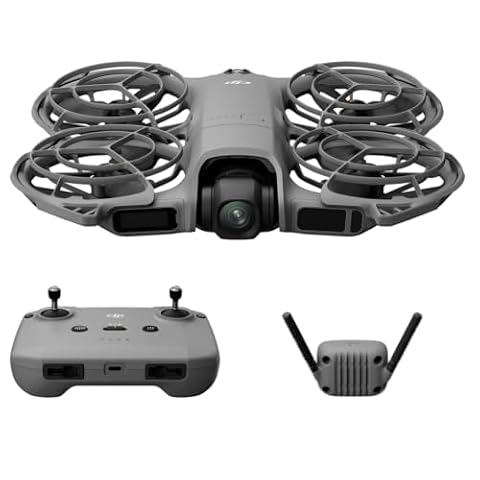
Best Camera Drones Under $1000: 13 Spec-Based Picks
Review 13 camera drones using published listing specifications. Compare sensor dimensions, video capture modes, and flight hardware to select the matching airframe for your recording goals.
As Amazon Associates, we earn from qualifying purchases. This means we may receive a small commission at no extra cost to you if you click through and make a purchase.
As an Amazon Associate we earn from qualifying purchases. Links on this page are affiliate links.
Finding the best camera drones under $1000 comes down to matching airframe hardware to your flight goals. We compared 13 models based strictly on the specifications published on their listings.
The DJI Mini 5 Pro 1-Inch CMOS Drone takes the top spot because its 1-inch CMOS sensor and omnidirectional obstacle sensing fit into an 8.78-ounce frame. This guide helps you choose the right balance of camera resolution, airframe weight, and flight controls for your aerial work.
Camera configuration determines your capture workflow
You must choose between standard directional video and complete spherical capture. A 360 camera like the DJI Avata 360 records 8K footage that you reframe in software after landing. In contrast, fixed-angle platforms like the Karuisrc 4K Drone record stabilized 4K video using a mechanical 3-axis gimbal directly during flight.
| # | Product | Best for | Price |
|---|---|---|---|
| 1 | DJI Mini 5 Pro 1-Inch CMOS Drone Best overall | Travel pilots needing portable 4K HDR video | |
| 2 | DJI FPV Drone Combo with Goggles Also great | high-speed immersive FPV flight and 4K recording | |
| 3 | DJI Avata 2 FPV Drone Combo Best budget | entry-level immersive FPV video recording | |
| 4 | DJI Mini 5 Pro 1-Inch CMOS Drone Also great | pocket-sized 4K HDR vertical aerial video | |
| 5 | Karuisrc 4K Drone with Touchscreen Remote Best 3-axis gimbal | long flights with dedicated touchscreen control | |
| 6 | DJI Avata 360 8K Camera Drone Best premium | reframable 8K 360-degree aerial filming | |
| 7 | HOVERAir X1 PROMAX 8K Flying Camera Also great | hands-free high-speed sports tracking | |
| 8 | DJI Mini 5 Pro 1-Inch Camera Drone Also great | sub-249g aerial photography with vertical shooting | |
| 9 | HOVERAir X1 PRO Cycling Follow Drone Best cycling | cyclists wanting automated hands-free follow footage | |
| 10 | Antigravity A1 8K 360 Drone Also great | hands-free 360-degree follow-me sports recording | |
| 11 | DJI Avata 4K FPV Drone Also great | immersive close-quarters first-person view flying | |
| 12 | Axisflying Cineon C35v3 3.5-Inch Drone Also great | ELRS pilots wanting a 6S cinematic cinewhoop | |
| 13 | Henrixonzx Bee35 Pro 3.5-Inch 6S Cinewhoop Also great | 6S FPV pilots using ELRS or TBS |
The best fit for you
- You want 4K video with omnidirectional obstacle sensing – DJI Mini 5 Pro 1-Inch CMOS Drone – Its 1-inch CMOS sensor and omnidirectional obstacle sensing provide 4K recording in an 8.78-ounce build.
- You need full spherical recording in 8K resolution – DJI Avata 360 8K Camera Drone – Its 360 camera configuration captures 8K video for complete reframing flexibility.
- You want stabilized 4K video with touchscreen control – Karuisrc 4K Drone with Touchscreen Remote – This model pairs a 3-axis gimbal and 4K recording with a dedicated touchscreen controller.
- You need a lightweight drone designed for cycling – HOVERAir X1 PRO Cycling Follow Drone – It features a 3.53-ounce frame, 4K capture, and dedicated support for cycling use.
Specification trade-offs in drones Under $1000
Drones Under $1000 give you 4K or 8K video resolution, but you compromise on specialized hardware. Sensor size tops out at a 1-Inch CMOS on select models, with no larger sensors documented in the listings. Only one option includes a 3-axis gimbal for stabilization. Omnidirectional obstacle sensing and smart features like follow me appear on select frames, while manual FPV and cinewhoop configurations omit them.
- Sensor size reaches a maximum of 1-Inch CMOS across listed models.
- Stabilization via a mechanical 3-axis gimbal is documented on only one model.
- Obstacle sensing is omitted entirely from cinewhoop and FPV entries.

DJI Mini 5 Pro 1-Inch CMOS Drone
Best for: Travel pilots needing portable 4K HDR video
- Video Resolution
- 4K/60fps HDR
- Sensor Size
- 1-inch CMOS
- Takeoff Weight
- 249.9 g ± 4 g
- Flight Time
- Up to 36 min
- Obstacle Sensing
- Omnidirectional
- Target Audience
- Beginners
The DJI Mini 5 Pro 4K Drone Combo pairs a 1-inch CMOS sensor with a 249.9-gram takeoff weight. You get 4K video at 60 fps in HDR, omnidirectional obstacle sensing with forward LiDAR, and 42GB of internal storage. With three batteries offering up to 36 minutes of flight each, it gives you extended airtime in a palm-sized setup.
- 1-inch CMOS sensor recording 4K/60fps HDR video
- Omnidirectional obstacle sensing backed by forward LiDAR
- Lightweight 249.9 g takeoff weight with foldable frame
- Up to 36 minutes of flight per battery with three included
- DJI Fly app requires direct download outside the Google Play Store
- Included RC-N3 remote requires a smartphone screen instead of a built-in display
- Recharging all three batteries takes roughly 115 minutes
- You want a sub-250g drone that captures 4K HDR footage with a 1-inch sensor.
- You plan to fly near obstacles and need multi-directional LiDAR protection.
- You need vertical video orientation supported natively by the gimbal.
- You prefer a remote controller with an integrated display instead of mounting your phone.
- You do not want to sideload flight apps on Android devices.
Verdict: DJI Mini 5 Pro 4K Drone Combo delivers 1-inch sensor video and LiDAR sensing in a sub-250-gram frame. It fits pilots who need multi-directional obstacle coverage and flexible vertical framing in a portable package.
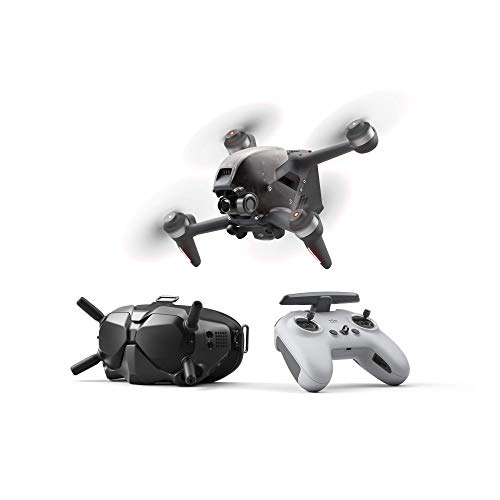
DJI FPV Drone Combo with Goggles
Best for: high-speed immersive FPV flight and 4K recording
- Video Resolution
- 4K/60fps
- Obstacle Sensing
- Forward and downward
- Transmission Range
- Up to 6.2 miles
- Dimensions
- 12.3 × 10 × 5 inches
- Weight
- 1.75 pounds
This renewed combo pairs an FPV quadcopter with DJI FPV Goggles V2 and a dedicated controller. You get 4K recording at 60 frames per second with a 120 Mbps bitrate and an ultra-wide 150-degree field of view. Its OcuSync 3.0 link transmits HD video up to 6.2 miles. It suits pilots seeking high-speed first-person flight with forward and downward obstacle sensors.
- Captures 4K video at 60 fps with a 120 Mbps bitrate
- OcuSync 3.0 transmission system reaches up to 6.2 miles
- Includes DJI FPV Goggles V2 with 150° field of view
- Forward and downward obstacle sensing with Smart Return to Home
- Obstacle sensing covers only forward and downward directions, lacking rear or lateral coverage
- At 1.75 pounds, the aircraft is heavier and less portable than sub-250g models
- You want immersive first-person flight using dedicated goggles with a 150° field of view.
- You need 4K capture at 60 fps with high-bitrate 120 Mbps recording.
- You operate in open areas where long-distance OcuSync 3.0 transmission is useful.
- You need full omnidirectional obstacle avoidance rather than forward and downward sensing.
- You require an ultralight drone lighter than 1.75 pounds for compact travel.
Verdict: DJI FPV Drone Combo with Goggles delivers high-speed first-person piloting with 4K60 video and long-range OcuSync 3.0 transmission. It fits flyers who prioritize goggle-based high-speed control over ultra-compact or omnidirectional folding platforms.

DJI Avata 2 FPV Drone Combo
Best for: entry-level immersive FPV video recording
- Video Resolution
- 4K/60fps
- Sensor Size
- 1/1.3-inch
- Dimensions
- 7.28 × 8.35 × 2.52 inches
- Weight
- 2.38 pounds
The DJI Avata 2 is an FPV drone combo packaged with DJI Goggles 3 and the RC Motion 3 controller. You get a 1/1.3-inch sensor recording 4K video at 60 frames per second with a 155-degree field of view. Integrated propeller guards shield the frame during close-range flying. It suits you if you want a complete first-person flying setup.
- Includes DJI Goggles 3 and DJI RC Motion 3 controller
- Records 4K video at 60fps with a 155-degree field of view
- Built-in propeller guards protect the airframe
- Equipped with a 1/1.3-inch image sensor
- Includes only one battery in this package
- Caps video resolution at 4K instead of 8K
- Features a 1/1.3-inch sensor rather than a 1-inch format
- You want a complete FPV kit with video goggles and motion controls included.
- You need integrated propeller guards for protection during close-quarters flights.
- You capture wide-angle aerial video in 4K resolution at 60fps.
- You require extra flight batteries bundled in the box.
- You need 8K capture capability or a 1-inch camera sensor.
Verdict: DJI Avata 2 4K FPV Drone Combo provides an all-in-one setup featuring motion steering and built-in rotor protection. It suits pilots looking for ready-to-fly first-person control paired with wide-angle 4K capture.

DJI Mini 5 Pro 1-Inch CMOS Drone
Best for: pocket-sized 4K HDR vertical aerial video
- Video Resolution
- 4K/60fps HDR
- Sensor Size
- 1-inch CMOS
- Obstacle Sensing
- Omnidirectional
- Dimensions
- 12 × 15 × 3.58 inches
- Weight
- 8.8 ounces
This palm-sized foldable quadcopter pairs a large 1-inch CMOS sensor with 4K/60fps HDR video capture. You get omnidirectional obstacle detection powered by forward-facing LiDAR, 42GB of onboard storage, and an active 225-degree gimbal roll for vertical filming. At 8.8 ounces, it suits travelers and outdoor creators needing portable imaging with automated subject tracking.
- 1-inch CMOS sensor capturing 4K/60fps HDR video
- Omnidirectional obstacle sensing with front-facing LiDAR
- 42GB of integrated internal storage
- 225-degree gimbal rotation enabling native vertical shooting
- Ultra-light 8.8-ounce foldable airframe
- Caps video capture at 4K/60fps rather than 8K resolution
- Bundle includes only one flight battery
- You want native vertical video and 4K/60fps footage from a 1-inch sensor.
- You need omnidirectional LiDAR obstacle sensing in an 8.8-ounce airframe.
- You prefer built-in 42GB storage to record without relying solely on cards.
- You require 8K capture resolution for oversized video workflows.
- You want multiple flight batteries supplied out of the box.
Verdict: DJI Mini 5 Pro 1-Inch CMOS Drone delivers compact 4K/60fps HDR capture with LiDAR obstacle detection and true vertical shooting for solo content creators.
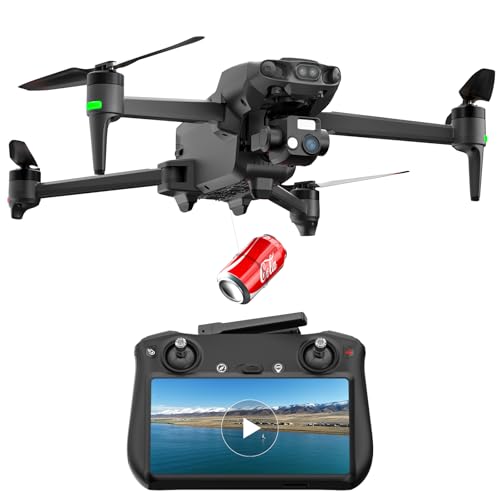
Karuisrc 4K Drone with Touchscreen Remote
Best for: long flights with dedicated touchscreen control
- Video Resolution
- 4K
- Flight Time
- 55 min
- Gimbal Stabilization
- 3-axis with EIS
- Transmission Range
- 15km
- Smart Features
- Auto Return, Follow Me
- Target Audience
- Travel
This quadcopter pairs a 4K camera on a 3-axis mechanical gimbal with electronic image stabilization for steady footage. You get a dedicated remote with an integrated 5.5-inch touchscreen, removing the need for a smartphone. With an 11.1V 3500mAh battery rated for 55 minutes of flight and a 15km transmission range, it suits pilots prioritizing extended flight sessions.
- 3-axis mechanical gimbal with electronic image stabilization
- Up to 55 minutes of flight time from an 11.1V 3500mAh battery
- Remote controller includes a built-in 5.5-inch touchscreen
- Transmission range reaches up to 15km
- Storage is limited to a 16GB micro SD card slot
- Lacks active obstacle avoidance sensing hardware
- You want a controller with a built-in screen so you do not have to attach your phone.
- You need long continuous airtime from a single battery charge.
- You require 3-axis mechanical stabilization combined with electronic image stabilization.
- You need omnidirectional obstacle avoidance sensors to prevent collisions.
- You plan to store video files locally on memory cards larger than 16GB.
Verdict: Karuisrc 4K Drone with Touchscreen Controller suits pilots who want stabilized 4K video and extended 55-minute flights without mounting a smartphone to the transmitter.

DJI Avata 360 8K Camera Drone
Best for: reframable 8K 360-degree aerial filming
- Video Resolution
- 8K/60fps HDR, 4K/60fps
- Sensor Size
- 1-inch-equivalent
- Obstacle Sensing
- Omnidirectional
- Transmission Range
- up to 20 km
- Camera Configuration
- 360 Camera
- Dimensions
- 9.69 × 7.83 × 2.19 inches
The DJI Avata 360 8K Camera Drone Combo is an aerial system featuring dual filming options. You get an 8K/60fps HDR 360-degree capture mode with 1-inch-equivalent sensors, alongside a standard 4K/60fps single-lens mode. It includes omnidirectional obstacle sensing, integrated propeller guards, and an O4+ transmission system reaching up to 20 km. This combo suits you if you need reframable aerial video.
- 8K/60fps HDR 360-degree capture with 1-inch-equivalent sensors
- O4+ video transmission with up to 20 km range at 1080p/60fps
- Nightscape omnidirectional obstacle sensing with integrated propeller guards
- Includes DJI RC 2 controller, three batteries, charging hub, and sling bag
- Standard single-lens mode drops capture resolution to 4K/60fps
- DJI Fly app requires direct download outside the Google Play store
- You want to capture full 360-degree footage and reframe perspectives in post-production.
- You need a bundled kit with three flight batteries and a dedicated display remote.
- You fly in tighter environments that benefit from built-in propeller guards.
- You rely solely on the Google Play store to download and update your drone apps.
- You need higher than 4K resolution when filming with a single directional lens.
Verdict: DJI Avata 360 8K Camera Drone Combo provides complete post-flight reframing flexibility through high-resolution 360-degree recording and long-range O4+ transmission. It fits aerial shooters who need multi-battery kits and omnidirectional obstacle coverage.
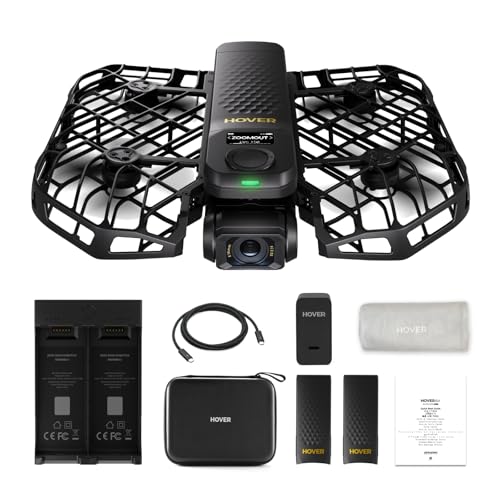
HOVERAir X1 PROMAX 8K Flying Camera
Best for: hands-free high-speed sports tracking
- Video Resolution
- 8K@30fps
- Obstacle Sensing
- Rear ToF and visual sensor
- Gimbal Stabilization
- Two-axis with EIS and HL
- Dimensions
- 6.81 × 5.87 × 1.54 inches
- Weight
- 6.77 ounces
The HOVERAir X1 PROMAX is a pocket-sized flying action camera built for hands-free tracking. It records 8K video at 30 fps horizontally through a 107-degree lens stabilized by a two-axis gimbal with electronic stabilization. The airframe weighs 6.77 ounces, reaches follow speeds up to 42 km/h, and includes rear collision sensors. It suits you if you need automated solo filming.
- Captures horizontal video at 8K resolution at 30 fps
- Tracks movement at follow speeds up to 42 km/h
- Includes 64GB onboard memory with expansion up to 1TB
- Lightweight 6.77-ounce folding body with enclosed propeller guards
- Two-axis gimbal stabilization instead of a three-axis mechanical system
- Obstacle avoidance limited to rear sensors
- You want hands-free 8K automated tracking for cycling or skiing
- You need a compact 6.77-ounce camera that launches directly from your palm
- You require three-axis mechanical gimbal stabilization
- You need front or omnidirectional obstacle avoidance sensors
Verdict: HOVERAir X1 PROMAX 8K Flying Action Camera delivers high-resolution automated tracking for solo cyclists and outdoor athletes who require palm takeoff without handling a separate controller.

DJI Mini 5 Pro 1-Inch Camera Drone
Best for: sub-249g aerial photography with vertical shooting
- Video Resolution
- 4K/60fps HDR
- Sensor Size
- 1-Inch CMOS
- Takeoff Weight
- Under 249g
- Obstacle Sensing
- Omnidirectional
- Gimbal Stabilization
- 225° Flexible Gimbal
- Transmission Range
- 20km
This bundle pairs DJI's sub-249-gram drone with a comprehensive accessory kit. You get a large 1-inch CMOS sensor capturing 4K video at 60 frames per second, a flexible 225-degree rotating gimbal for vertical shooting, and omnidirectional obstacle sensing with forward LiDAR. It suits you if you want high-grade camera hardware in an ultralight frame ready for travel.
- 1-inch CMOS sensor with 4K/60fps HDR video capture
- Sub-249g takeoff weight requires no standard registration
- Omnidirectional obstacle sensing paired with forward-facing LiDAR
- 225-degree flexible gimbal rotation for native vertical shooting
- 42GB integrated internal storage
- Video resolution caps at 4K rather than 8K
- Kit does not include extra flight batteries
- You want a large 1-inch sensor in a sub-249-gram airframe.
- You produce vertical video content directly from the gimbal.
- You want forward LiDAR obstacle detection for low-light navigation.
- You need 8K recording capabilities.
- You require multiple flight batteries included in the package.
Verdict: DJI Mini 5 Pro 1-Inch Sensor Drone fits creators who want a 1-inch sensor, 20km transmission range, and full obstacle sensing without exceeding the 249-gram weight threshold.
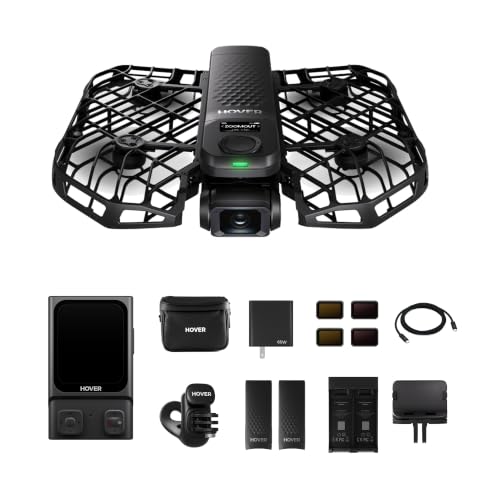
HOVERAir X1 PRO Cycling Follow Drone
Best for: cyclists wanting automated hands-free follow footage
- Video Resolution
- 4K@60fps
- Obstacle Sensing
- Rear ToF proximity sensor
- Gimbal Stabilization
- 2-axis with EIS and HL
- Transmission Range
- 1km
- Recommended Use
- Cycling
- Dimensions
- 6.81 × 5.87 × 1.54 inches
This compact flying camera tracks your rides without a phone or traditional flight controller. It records 4K video at 60 fps using a two-axis gimbal with horizon leveling. You get an included Beacon with a 1.78-inch OLED screen that preserves a 1-kilometer connection at follow speeds up to 42 km/h. It suits cyclists needing hands-free tracking.
- Tracks movement at speeds up to 42 km/h with 60 km/h burst capability
- Records 4K video at 60 fps with electronic stabilization and horizon leveling
- Weighs 3.53 ounces with fully enclosed propeller guards
- Includes Beacon module with 1.78-inch OLED display and 1-kilometer range
- Stabilization uses a two-axis mechanical gimbal rather than a three-axis setup
- Obstacle detection is limited to a rear ToF proximity sensor
- Maximum transmission range reaches only 1 kilometer
- You need autonomous subject tracking up to 42 km/h for bike rides.
- You prefer palm takeoff without managing a full-size flight controller.
- You want enclosed propeller guards on a lightweight 3.53-ounce frame.
- You need full three-axis mechanical gimbal stabilization.
- You require forward or omnidirectional obstacle avoidance sensors.
Verdict: HOVERAir X1 PRO Cycling Follow Drone gives cyclists a dedicated follow camera with reliable 42 km/h automated tracking and enclosed safety guards. It fits riders who prioritize hands-free operation and high follow speeds over multi-axis gimbals and long-distance flight.

Antigravity A1 8K 360 Drone
Best for: hands-free 360-degree follow-me sports recording
- Video Resolution
- 8K 360
- Obstacle Sensing
- Omnidirectional
- Transmission Range
- 10km
- Camera Configuration
- 360 Camera
- Smart Features
- Auto Return, Follow Me
- Dimensions
- 12.2 × 8.5 × 3.51 inches
The Antigravity A1 is a follow-me drone equipped with an 8K 360 camera and omnidirectional obstacle sensing. It features a 10km transmission range alongside GPS and visual tracking for automated following. Full-coverage propeller guards protect the craft during motion-controlled flights. This setup suits you if you want hands-free reframing in post-production using watch-based controls without piloting manually.
- Omnidirectional obstacle avoidance paired with full-coverage propeller guards
- 8K 360-degree video capture allows post-flight reframing
- 10km transmission range with GPS and visual tracking
- Wrist-mounted Watch Remote and Drag-to-Fly motion control
- Weight of 5.29 pounds is significantly heavier than compact ultralight alternatives
- Chassis footprint of 12.2 by 8.5 inches takes up substantial pack space
- You want 8K 360-degree footage that lets you adjust camera angles in post-production.
- You prefer autonomous tracking managed via a wrist-worn Watch Remote.
- You need omnidirectional obstacle detection combined with physical propeller guards.
- You require an ultralight drone under 249 grams for compact travel.
- You prefer a folding airframe rather than a rigid 12.2 by 8.5-inch body.
Verdict: Antigravity A1 8K 360 Camera Drone fits outdoor sports enthusiasts who prioritize autonomous follow-me tracking with full spherical capture over low carrying weight. Its built-in propeller guards and omnidirectional sensors accommodate automated flights along trails and roads.

DJI Avata 4K FPV Drone
Best for: immersive close-quarters first-person view flying
- Video Resolution
- 4K
- Sensor Size
- 1/1.7-inch
- Flight Time
- 18-minute
- Transmission Range
- Up to 10 km
- Dimensions
- 7 × 7 × 3.14 inches
- Weight
- 14.5 ounces
The DJI Avata 4K FPV Drone pairs a 1/1.7-inch sensor with an ultra-wide 155-degree field of view to capture stabilized 4K footage. You get DJI Goggles 2 and the RC Motion 2 controller for immersive motion-based steering. With built-in propeller guards, an 18-minute flight time, and a 10 km transmission range, this setup suits you if you want tight-space FPV flying.
- Built-in propeller guards protect during minor contact
- Up to 10 km video transmission range via DJI O3+
- Super-wide 155° field of view with 4K stabilized video
- Includes DJI Goggles 2 and RC Motion 2 controller
- 18-minute flight time is shorter than standard camera drones
- 1/1.7-inch sensor is smaller than 1-inch sensor alternatives
- You want an immersive first-person flight experience with included video goggles.
- You plan to navigate tight indoor or outdoor spaces where built-in prop guards prevent damage.
- You need flight times longer than 18 minutes on a single battery charge.
- You prioritize a larger 1-inch camera sensor over FPV agility.
Verdict: DJI Avata 4K FPV Drone delivers agile close-quarters first-person flight with integrated prop guards for pilots who prioritize motion control over long battery endurance.

Axisflying Cineon C35v3 3.5-Inch Drone
Best for: ELRS pilots wanting a 6S cinematic cinewhoop
- Features
- GPS
- Dimensions
- 0.39 × 0.39 × 0.39 inches
- Weight
- 1.76 ounces
This 3.5-inch cinewhoop drone pairs an F745 all-in-one flight controller with 6S power support and integrated GPS. Configured as a Bind-and-Fly unit with an O4-compatible setup and ELRS 2.4GHz receiver, it gives you stable cinematic flight paths. It suits experienced pilots who already own compatible goggles and a radio controller.
- Integrated GPS module for positioning
- F745 AIO flight controller with AM32 firmware
- 6S power architecture support
- ELRS 2.4GHz receiver configuration
- BNF format excludes a remote controller and FPV goggles
- Data lists no included flight battery or charger
- You fly 6S battery setups with an ELRS 2.4GHz radio.
- You want an integrated GPS module on a 3.5-inch cinewhoop.
- You already own compatible FPV goggles and gear.
- You want a ready-to-fly kit with a bundled controller and goggles.
- You need an automated camera drone with a motorized gimbal.
Verdict: Axisflying Cineon C35v3 3.5-Inch Drone delivers 6S power and GPS telemetry in a compact cinewhoop frame for pilots who already have an ELRS radio and FPV gear.

Henrixonzx Bee35 Pro 3.5-Inch 6S Cinewhoop
Best for: 6S FPV pilots using ELRS or TBS
- Dimensions
- 0.39 × 0.39 × 0.39 inches
- Weight
- 1.76 ounces
You get a 3.5-inch cinewhoop FPV platform engineered for 6S power setups. At a listed weight of 1.76 ounces, this build supports compact flying. It offers radio receiver configurations including Analog ELRS and Analog TBS. This quad suits pilots who already own compatible FPV gear and want a dedicated 3.5-inch 6S platform.
- Built for 6S power systems
- Available in Analog ELRS and Analog TBS receiver configurations
- Listed weight of 1.76 ounces
- No integrated camera specifications listed
- Lacks GPS hardware in the specifications
- You fly with 6S battery setups.
- You use ELRS or TBS radio transmitters.
- You need a drone with factory-documented camera hardware.
- You require built-in GPS positioning.
Verdict: Henrixonzx Bee35 Pro 3.5-Inch 6S Cinewhoop fits experienced FPV pilots seeking a 3.5-inch 6S platform with ELRS or TBS compatibility.
Specifications side by side
| Spec | DJI Mini 5 Pro 1-Inch CMOS Drone | DJI FPV Drone Combo with Goggles | DJI Avata 2 FPV Drone Combo | DJI Mini 5 Pro 1-Inch CMOS Drone | Karuisrc 4K Drone with Touchscreen Remote | DJI Avata 360 8K Camera Drone | HOVERAir X1 PROMAX 8K Flying Camera | DJI Mini 5 Pro 1-Inch Camera Drone | HOVERAir X1 PRO Cycling Follow Drone | Antigravity A1 8K 360 Drone | DJI Avata 4K FPV Drone | Axisflying Cineon C35v3 3.5-Inch Drone | Henrixonzx Bee35 Pro 3.5-Inch 6S Cinewhoop |
|---|---|---|---|---|---|---|---|---|---|---|---|---|---|
| Video Resolution | 4K/60fps HDR | 4K/60fps | 4K/60fps | 4K/60fps HDR | 4K | 8K/60fps HDR, 4K/60fps | 8K@30fps | 4K/60fps HDR | 4K@60fps | 8K 360 | 4K | – | – |
| Sensor Size | 1-inch CMOS | – | 1/1.3-inch | 1-inch CMOS | – | 1-inch-equivalent | – | 1-Inch CMOS | – | – | 1/1.7-inch | – | – |
| Takeoff Weight | 249.9 g ± 4 g | – | – | – | – | – | – | Under 249g | – | – | – | – | – |
| Flight Time | Up to 36 min | – | – | – | 55 min | – | – | – | – | – | 18-minute | – | – |
| Obstacle Sensing | Omnidirectional | Forward and downward | – | Omnidirectional | – | Omnidirectional | Rear ToF and visual sensor | Omnidirectional | Rear ToF proximity sensor | Omnidirectional | – | – | – |
| Gimbal Stabilization | – | – | – | – | 3-axis with EIS | – | Two-axis with EIS and HL | 225° Flexible Gimbal | 2-axis with EIS and HL | – | – | – | – |
| Transmission Range | – | Up to 6.2 miles | – | – | 15km | up to 20 km | – | 20km | 1km | 10km | Up to 10 km | – | – |
| Stabilization | – | – | – | – | 3-Axis Gimbal | – | – | – | – | – | – | – | – |
| Camera Configuration | – | – | – | – | – | 360 Camera | – | – | – | 360 Camera | – | – | – |
| Smart Features | – | – | – | – | Auto Return, Follow Me | – | – | – | – | Auto Return, Follow Me | – | – | – |
| Target Audience | Beginners | – | – | – | Travel | – | – | Beginners | – | – | – | – | – |
| Features | – | – | – | – | GPS, Touchscreen | – | – | – | – | – | – | GPS | – |
| Recommended Use | – | – | – | – | – | – | – | – | Cycling | – | – | – | – |
| Dimensions | 12 × 15 × 3.58 inches | 12.3 × 10 × 5 inches | 7.28 × 8.35 × 2.52 inches | 12 × 15 × 3.58 inches | 16 × 3 × 16 inches | 9.69 × 7.83 × 2.19 inches | 6.81 × 5.87 × 1.54 inches | 6.2 × 5.1 × 1.9 inches | 6.81 × 5.87 × 1.54 inches | 12.2 × 8.5 × 3.51 inches | 7 × 7 × 3.14 inches | 0.39 × 0.39 × 0.39 inches | 0.39 × 0.39 × 0.39 inches |
| Weight | 8.78 ounces | 1.75 pounds | 2.38 pounds | 8.8 ounces | 8.78 ounces | 1 pounds | 6.77 ounces | 280 pounds | 3.53 ounces | 5.29 pounds | 14.5 ounces | 1.76 ounces | 1.76 ounces |
| Size | 7.00 | 12.3 x 10 x 5 inches | Avata 2 Fly More Combo (1 Battery) | – | – | 7.79 | Combo | – | Sld | – | – | Millennial pink | PW Version |
| Color | Grey | Black | Black | Graphite | Starry Black | Black | Black | gray | Black | WHITE | Black | O4 PRO ELRS 2.4G | One Color |
| Model | 6937224123090 | – | QF3W4K | – | – | 6937224137622 | ZZ-H-1-004 | – | 001 | – | CP.FP.00000129.01 | EasQjK77521 | Henrixonzx26 |
If you want a larger sensor without flight capability, compare specs across the best mirrorless cameras under 1000.
How We Picked These Drones
We build this guide using published specifications and feature lists. Models qualify when they fall Under $1000. You see only one variant per product family to keep choices straightforward. We do not physically handle or test the drones. Instead, we compare listed features so you can evaluate the hardware directly.
We order items with products in stock first, then by Amazon sales rank, with better-selling products first. Drones move in or out of this guide as listings change. Availability refreshes at least daily on the page, keeping the 13 picks current for 2026.
How to Choose Your Camera Drone
Sensor Size Selection
You should check the camera sensor size if you plan to shoot in changing lighting conditions. Larger physical sensors gather more light and preserve highlight and shadow details better than smaller sensors. In this category, the DJI Mini 5 Pro provides a 1-Inch CMOS sensor. If your flights occur mostly in bright daylight, sensor dimensions matter less than overall resolution. Check the sensor specifications to ensure the hardware matches your environment.
Total Airframe Weight
You need to inspect the published weight before purchasing. Drone weights in this range vary widely, from pocket-sized units to heavier builds over five pounds. Ultra-light platforms like the HOVERAir X1 PRO weigh just 3.53 ounces, making them simple to slip into a pack. Heavier frames handle wind gusts more firmly but demand more carrying space. Select an airframe weight that aligns with your transport method and local flight rules.
Mechanical Gimbal Stabilization
You must evaluate how the camera dampens motor vibration and wind turbulence. Mechanical hardware like a 3-axis gimbal physically counteracts tilt and roll during aggressive maneuvers, producing steady horizon lines. The Karuisrc 4K Drone incorporates a 3-axis gimbal to stabilize video mechanically. Drones without mechanical stabilization rely on electronic smoothing or steady forward paths. Check the stabilization spec if you prioritize cinematic video over high-speed manual maneuvers.
Obstacle Sensing Coverage
You should determine whether you need automated crash prevention or manual line-of-sight flying. Systems with omnidirectional obstacle sensing scan surrounding paths to detect trees, walls, and terrain hazards automatically. The Antigravity A1 8K 360 Drone integrates omnidirectional sensors alongside protective guards for automated trail flights. Manual platforms often omit these sensors to reduce weight. Compare the listed sensor coverage against your primary flight environment.
Video Resolution Options
You should match video resolution to your post-production workflow and editing hardware. Standard 4K resolution provides sharp playback on modern displays while keeping file sizes manageable on memory cards. Higher 8K resolution, found on the HOVERAir X1 PROMAX, lets you crop frames closely without losing fine details. However, 8K files require faster processing hardware to edit smoothly. Check the video resolution spec against your computer capabilities.
Radio Protocol Compatibility
You must check receiver compatibility if you fly existing FPV equipment. Some cinewhoop models arrive without standard bundled remotes, relying instead on open-source radio links. The Axisflying Cineon C35v3 uses an ELRS 2.4G protocol, requiring a compatible transmitter to establish control. All-in-one consumer kits supply their own matched controllers directly in the package. Check whether a drone requires your own radio before purchasing.
Frequently asked questions
Can you fly camera drones indoors safely?
You can fly certain models indoors if they feature built-in rotor protection. Models like the DJI Avata 2, DJI Avata 4K, and Antigravity A1 include integrated propeller guards to prevent blade contact with interior walls. Airframes lacking enclosed guards require open clearance and omnidirectional sensors to navigate tight indoor spaces safely.
Do camera drones require you to connect a smartphone?
You do not always need a smartphone to operate these drones. The Karuisrc 4K Drone includes a dedicated touchscreen remote that eliminates phone mounting. Additionally, the HOVERAir X1 PROMAX operates via palm takeoff without handling a separate controller or phone, while FPV platforms stream video directly into flight goggles.
What is the advantage of a cinewhoop drone?
A cinewhoop gives experienced pilots compact agility and high-voltage power for specialized filming. Models such as the Axisflying Cineon C35v3 and Henrixonzx Bee35 Pro utilize 3.5-inch frames paired with 6S battery power. These platforms link directly to external radio protocols like ELRS or TBS, giving you precise manual control during high-speed maneuvers.
How does automated follow-me tracking work on action drones?
Automated tracking follows your movement autonomously using built-in sensors or optical targets. For example, the HOVERAir X1 PRO tracks cyclists hands-free at speeds up to 42 km/h. Other drones, such as the Antigravity A1 and Karuisrc 4K Drone, integrate follow-me routines with auto-return systems to keep you centered in the frame automatically.
What makes an FPV drone different from a standard camera drone?
An FPV drone provides an immersive first-person viewpoint transmitted directly to head-mounted goggles. The DJI FPV Drone Combo uses OcuSync 3.0 transmission for high-speed piloting, while the DJI Avata 2 relies on motion steering controllers. Standard camera drones prioritize hovering stability, whereas FPV models focus on pilot immersion and dynamic flight angles.
How does LiDAR improve obstacle avoidance on camera drones?
LiDAR technology measures distance using laser pulses to map immediate surroundings with high precision. On the DJI Mini 5 Pro, LiDAR obstacle detection works alongside omnidirectional sensing to detect hazards across multiple directions. This active scanning helps prevent collisions near thin branches or obstacles that traditional vision-only systems might miss in varied environments.
Can you capture true vertical video for social platforms?
You can shoot native vertical video on specific models without cropping horizontal frames in software. The DJI Mini 5 Pro includes true vertical shooting to record 4K HDR footage framed for vertical screens. This orientation preserves the full sensor resolution, unlike manual post-production cropping that discards image data from standard horizontal video clips.