Choosing Action Cameras in 2026: The Specs That Matter and 8 Picks
Compare video resolution, stabilization, and form factors to match your outdoor environment. Check verified hardware specifications so you choose the right camera for your needs.
As Amazon Associates, we earn from qualifying purchases. This means we may receive a small commission at no extra cost to you if you click through and make a purchase.
As an Amazon Associate we earn from qualifying purchases. Links on this page are affiliate links.
This action camera buying guide helps you select the right device based on verified hardware capabilities. You will be able to decide which camera matches your physical mounting needs, outdoor environments, and video standards. The guide walks you through core differences in video resolution from 4K up to 8K, sensor sizes from 1/1.9-inch to 1-inch CMOS, bare-camera waterproofing down to 20 meters, and device weights from 4.37 ounces to 11.5 ounces.
The 8 models for 2026 were chosen strictly from their published specifications rather than promotional claims. After reviewing these specs, you can decide whether your projects require a lightweight build for hands-free POV vlogging, a 360 camera configuration for full reframing, or sub-zero battery performance and deep waterproofing for winter sports and diving.
Key Action Camera Hardware Specifications
Video Resolution
Video resolution determines the clarity, pixel count, and cropping flexibility of your footage. Standard action cameras provide 4K recording, which fits standard video workflows and avoids excessive storage demands. Stepping up to 5.3K allows you to crop or stabilize clips in post-production without dropping below ultra-high-definition output. High-end hardware offers 8K capture, maximizing fine detail across broad landscapes or multi-directional views. However, higher resolutions produce larger files, require faster memory cards, and place higher processing demands on your editing computer. If you plan to share straightforward outdoor clips online, 4K delivers sharp results with simpler editing. Choose higher resolutions like 5.3K or 8K if you need room for framing adjustments later. The GoPro HERO12 Black provides 5.3K recording for enhanced detail.
Look for
- Native 4K capture for baseline clarity and manageable video file sizes
- 5.3K or 8K options for digital cropping and reframing flexibility
Image Sensor Size
The physical size of the camera sensor dictates how much light reaches the pixels during recording. Common action camera sensors measure 1/1.9 inches, 1/1.3 inches, 1/1.1 inches, or a full 1-inch CMOS type. Larger sensors collect more light naturally, resulting in cleaner frames with reduced grain in shaded woods, twilight, or overcast skies. They also offer improved dynamic range, preserving highlights in bright skies and details in shadows. The trade-off is optical depth and physical unit dimensions. Compact action cameras must balance lens optics with sensor area to avoid bulky frames. A 1/1.3-inch sensor balances low-light intake with portable dimensions, while a 1/1.1-inch or 1-inch sensor prioritizes maximum image quality. The DJI Osmo Action 4 uses a 1/1.3-inch sensor to improve light collection.
Look for
- Sensor dimensions of 1/1.3-inch or larger for better dim-light performance
- Full 1-inch CMOS sensors for expanded dynamic range and cleaner highlights
Camera Weight and Form Factor
Camera weight directly affects where and how long you can comfortably mount your gear. Standard action cameras weigh between 5 and 11.5 ounces, providing rigid stability on handlebars, chest harnesses, or vehicle bars. Heavier cameras stay steady during high-speed vibrations but pull noticeably on lightweight helmets or cap clips. Ultra-compact wearable units weigh under 5 ounces, making them practical for magnetic shirt mounts, pet collars, or unobtrusive travel filming. The trade-off comes down to thermal management and integrated components. Lighter cameras pack smaller chassis space, which often limits internal heat dissipation or battery volume compared to full-sized units. For active sports where mass causes fatigue, lower weights offer genuine advantages. The Insta360 GO 3S weighs just 4.52 ounces for comfortable point-of-view wearing.
Look for
- Sub-5-ounce total weight for hats, clothing mounts, and lightweight rigs
- Sturdy 5-to-11-ounce bodies for rigid handlebar and vehicle brackets
Camera Configuration and Lens Type
Camera configuration determines how your scene is framed and recorded during motion. Standard single-lens action cameras capture a fixed forward field of view, making them simple to aim and quick to produce standard rectangular video. Spherical 360-degree cameras capture an entire scene at once using opposing lenses. This setup lets you choose camera angles and reframing perspectives after recording completes, ensuring you never miss fast action behind you. Dual-lens configurations can also deliver multi-focal lengths, pairing wide views with telephoto options for focused subjects. The compromise for 360 models involves exposed domed lenses and required post-processing software before video export. If you want simple point-and-record footage, choose a standard layout. The Insta360 X6 uses a 360 camera configuration for complete spherical reframing.
Look for
- Single-lens layouts for fast, standard point-and-shoot video creation
- Dual-lens or 360-degree configurations for complete spherical reframing
Native Waterproof Depth
Native waterproofing defines how deep an action camera can submerge without requiring a separate dive housing. Deep-rated models withstand water pressure down to 20 meters directly out of the box, making them reliable for open-water swimming, surfing, and scuba diving. A bare waterproof chassis reduces weight, eliminates lens port fogging, and preserves clear microphone audio underwater. Non-submersible or lightly splashproof cameras require add-on waterproof cases for marine activities, which add bulk and can muffle sound recording. However, cameras engineered for deep submersion often feature sealed doors and reinforced ports that require careful latch checking to keep seals intact. If water sports or wet environments are central to your activities, verified bare-camera depth is critical. The DJI Osmo Action 6 provides native bare-camera waterproofing down to 20 meters.
Look for
- Deep 20-meter bare-camera waterproofing for diving and water sports
- Submersion-safe chassis designs that avoid bulky external dive housings
Image Stabilization System
Action recording involves intense vibrations, jarring impacts, and rapid directional shifts. Electronic and mechanical stabilization systems counteract these movements to produce steady, watchable footage without external gimbals. Advanced digital stabilization analyzes sensor data to smooth high-frequency shakes on trails, gravel roads, or rough descents. Mechanical systems physicalize stabilization across lens assemblies, helping maintain framing without cropping sensor edges. The trade-off with digital stabilization is an unavoidable field-of-view crop, as the algorithm uses edge pixels to cushion motion. Heavy stabilization in low light can also introduce digital blur artifacts if shutter speeds drop too low. If you record dynamic sports like mountain biking or skiing, dependable stabilization is necessary to prevent disorienting footage. The DJI Osmo Action 5 Pro features built-in stabilization for steady sports vlogging.
Look for
- Advanced electronic stabilization to smooth rough terrain and vibrations
- Mechanical stabilization options that retain full sensor field of view
Display and Streaming Utility
Versatile hardware utilities expand an action camera beyond typical outdoor sports recording. Features like integrated touchscreens simplify on-the-fly menu adjustments, frame composition, and clip playback in the field. Remote-monitoring displays let you verify framing when the camera sits out of reach. Additionally, connectivity modes such as live streaming and webcam functionality allow you to use your action camera as a desktop video source or real-time broadcast tool. The trade-off is battery drain and system heat. Running wireless transmission or continuous preview displays consumes more power, reducing single-session runtime during long recordings. If you plan to produce vlogs, broadcast live events, or record desk presentations, verify these workflow capabilities before purchasing. The Insta360 Luna features a touchscreen display for remote monitoring and vlogging.
Look for
- Integrated touchscreens for direct menu control and framing checks
- Live streaming and webcam modes for versatile multi-purpose broadcasting
Action Camera Form Factors and Types
Standard Rugged Action Cameras
Standard rugged action cameras feature boxed enclosures built for direct outdoor exposure without separate housing. Models like the DJI Osmo Action 4 and GoPro HERO12 Black include built-in stabilization, waterproof seals, and direct lens protection. You benefit from standardized mounts and multi-angle viewing screens. These cameras suit athletes, divers, and trail riders who require durable chassis designs for high-impact activities. The primary trade-off is physical bulk. Because the bodies carry reinforced housings and internal batteries, they weigh between five and twelve ounces, making them heavier to mount on hats or clothing.
Miniature Wearable Action Cameras
Miniature wearable cameras prioritize reduced physical dimensions and lightweight bodies for discreet point-of-view recording. Devices such as the Insta360 GO 3S and DJI Osmo Nano weigh around 4.5 ounces and utilize magnetic mounting systems. You can attach them directly to shirts, caps, or lanyards without heavy harness hardware. This form factor suits everyday vloggers, runners, and travelers seeking quick hands-free capture. The primary trade-off is reduced thermal mass and battery runtime. Because the compact enclosures limit component space, these units offer fewer external physical ports and rely on docking modules or charging cases for extended sessions.
360-Degree Spherical Cameras
Spherical 360 cameras utilize dual opposing ultra-wide lenses to record an entire environment simultaneously. Models like the Insta360 X6 provide high-resolution capture up to 8K across a 360-degree field of view. You do not need to point the lens while moving, since you reframe angles and perspectives in post-production software. This configuration suits action videographers, skiers, and solo creators who want dynamic third-person perspectives from a single pass. The trade-off centers on exposure vulnerability and processing overhead. The curved, protruding glass lenses lack flat protective covers, increasing scratch risks, while spherical video files require post-processing and substantial storage bandwidth.
Dual-Lens Vlogging Cameras
Dual-lens vlogging cameras pair multi-focal optical hardware with specialized display setups for production-focused recording. Options like the Insta360 Luna offer optical zoom capabilities and multi-angle monitoring alongside 8K video resolution. You get framing flexibility for seated presentations, interviews, and remote production setups without swapping prime lenses. This format suits video podcasters, product demonstrators, and solo vloggers who need precise framing control rather than extreme shock resistance. The main trade-off is reduced outdoor durability. Because these cameras emphasize movable screens and optical zoom components, they sacrifice the impact resistance and native submersion waterproofing found on conventional bare-body action hardware.
Action Camera Buying Mistakes to Avoid
Buying a memory card with insufficient sustained write speed
High bitrate recording halts if your microSD card lacks adequate write speeds. Slow cards cause dropped frames and corrupted video files. Verify your camera requires U3, V30, or V60 bus speeds before buying media. Match the continuous write spec of the card directly to the maximum bitrate of your selected video profile.
Ignoring audio connectivity specs and internal microphone wind filters
Built-in microphones often capture excessive wind noise during high-speed activities. Integrated waterproof membranes muffle external sound unless specialized wind reduction modes exist. Check whether the camera supports dedicated USB-C audio input adapters or external microphone protocols. If recording clear speech matters, verify compatibility with wireless microphone receivers before making your choice.
Overlooking operating temperature ratings for cold weather usage
Standard lithium-ion action camera batteries suffer severe voltage drops in sub-freezing temperatures, causing sudden shutdowns. If you record winter sports, check for cold-weather battery chemistry ratings or operating specs rated down to minus four degrees Fahrenheit. Ensure replacement batteries are readily available and check whether external USB power delivery operates without internal batteries installed.
Assuming fixed lenses perform well in low-light environments
Small action camera image sensors paired with slow aperture lenses struggle in dim lighting. Electronic image stabilization compounds this issue by introducing motion blur when shutter speeds drop. Check the physical sensor dimensions and maximum lens aperture specs. For night or indoor use, select larger sensor formats and plan to add external continuous lighting.
| # | Product | Best for | Price |
|---|---|---|---|
| 1 | Insta360 GO 3S 128GB 4K Action Camera | Hands-free POV vlogging and ultralight mounting | |
| 2 | DJI Osmo Action 4 4K Action Camera | cold-weather sports and deep underwater filming | |
| 3 | GoPro HERO12 Black 5.3K Action Camera | high-resolution action recording with advanced stabilization | |
| 4 | Insta360 X6 8K 360 Camera | high-resolution 8K 360-degree reframing and recording | |
| 5 | DJI Osmo Action 6 8K Action Camera | Deep-water filming and high-resolution 8K action capture | |
| 6 | Insta360 Luna Dual-Lens 8K Camera | telephoto vlogging and remote-monitored video production | |
| 7 | DJI Osmo Action 5 Pro 4K Action Camera | deep diving and cold-weather sports recording | |
| 8 | DJI Osmo Nano 4K Wearable Camera | compact hands-free POV vlogging and sports |

Insta360 GO 3S 128GB 4K Action Camera
Best for: Hands-free POV vlogging and ultralight mounting
- Video Resolution
- 4K
- Stabilization
- FlowState Stabilization
- Battery Life
- 140 minutes
- Waterproof Depth
- 10m
- Recommended Use
- Vlogging
- Dimensions
- 24.8 × 25.6 × 54.4 inches
The Insta360 GO 3S is a miniature action camera weighing 1.4 ounces that records in 4K resolution. You can mount it magnetically for hands-free point-of-view capture or dock it into the included Action Pod, which provides a 2.2-inch flip screen and up to 140 minutes of total battery life. It suits you if you prioritize lightweight, wearable mounting.
- Standalone camera body weighs 1.4 ounces (39 grams)
- Action Pod adds a 2.2-inch flip screen and 140-minute total runtime
- Standalone camera module is waterproof down to 10 meters (IPX8)
- FlowState Stabilization and Horizon Lock keep footage level
- Maximum video resolution reaches 4K rather than 5.3K or 8K
- Action Pod housing is limited to IPX4 splash resistance
- You want an ultralight camera body for magnetic, hands-free POV shooting
- You need a flip-up preview screen for vlogging framing
- You want to submerge the standalone camera up to 10 meters without an extra housing
- You require capture resolutions higher than 4K
- You plan to fully submerge the Action Pod without a dive case
Verdict: Insta360 GO 3S Miniature 4K Action Camera delivers lightweight magnetic mounting for creators who want hands-free point-of-view video without wearing a full-sized action camera rig.

DJI Osmo Action 4 4K Action Camera
Best for: cold-weather sports and deep underwater filming
- Video Resolution
- 4K/120fps
- Sensor Size
- 1/1.3-inch
- Battery Life
- Up to 150 minutes
- Waterproof Depth
- 18m
- Field Of View
- 155°
- Dimensions
- 2.78 × 1.74 × 1.29 inches
The DJI Osmo Action 4 is a rugged action camera designed for outdoor sports and water recording. You get a 1/1.3-inch sensor recording up to 4K at 120fps, an ultra-wide 155-degree field of view, and native waterproofing down to 18 meters. Its 1770mAh battery runs for 150 minutes, making it suitable for cold-weather filming down to -20°C.
- 1/1.3-inch sensor with 2.4μm pixel size
- Native waterproofing down to 18 meters
- Cold-resistant battery operating down to -20°C (-4°F)
- 4K video capture at up to 120fps with a 155° FOV
- Maximum video resolution caps at 4K rather than 5.3K or 8K
- Product specifications list no onboard internal storage
- You need reliable battery performance in freezing temperatures down to -20°C.
- You want native 18-meter depth waterproofing without adding an external case.
- You film high-speed motion requiring 4K capture at 120 frames per second.
- You require capture resolutions above 4K for reframing or cropping.
- You want built-in internal memory rather than relying entirely on memory cards.
Verdict: DJI Osmo Action 4 4K Action Camera suits divers, winter sports athletes, and motorcyclists who prioritize deep waterproofing and sub-zero battery performance over resolution above 4K.

GoPro HERO12 Black 5.3K Action Camera
Best for: high-resolution action recording with advanced stabilization
- Video Resolution
- 5.3K60
- Sensor Size
- 1/1.9"
- Stabilization
- HyperSmooth 6.0
- Waterproof Depth
- 33ft (10m)
- Photo Resolution
- 27MP
- Features
- Stabilization, Live Streaming, Webcam Mode
The GoPro HERO12 Black records 5.3K video at up to 60 frames per second and captures 27MP still photos using a 1/1.9-inch sensor. It includes HyperSmooth 6.0 stabilization and operates underwater down to 33 feet without external housing. This camera suits you if you need high-resolution video capture and reliable stabilization for fast-moving sports.
- 5.3K video recording at 60 fps with HDR support
- HyperSmooth 6.0 stabilization with AutoBoost
- 27MP photo resolution and 24.7MP frame grabs
- Waterproof down to 33 feet without an extra housing
- 1/1.9-inch sensor is smaller than the 1/1.3-inch and 1/1.1-inch sensors on competing cameras
- Video resolution caps at 5.3K instead of 8K
- You record high-speed activities requiring HyperSmooth 6.0 stabilization.
- You want 5.3K video and 27MP photo resolution in one body.
- You need native water resistance down to 33 feet without separate dive cases.
- You need 8K capture for cropping flexibility in editing.
- You require a larger 1/1.3-inch or 1/1.1-inch sensor for your shooting conditions.
Verdict: GoPro HERO12 Black 5.3K Action Camera delivers 5.3K60 capture and HyperSmooth 6.0 stabilization for sports shooters needing high-resolution outdoor performance without an external waterproof case.

Insta360 X6 8K 360 Camera
Best for: high-resolution 8K 360-degree reframing and recording
- Video Resolution
- 8K50fps
- Sensor Size
- 1/1.1"
- Battery Life
- 140 minutes
- Field Of View
- 170°
- Camera Configuration
- 360 Camera
The Insta360 X6 is a dual-lens 360 action camera built around two 1/1.1-inch sensors. You can record 360-degree footage at up to 8K at 50 fps, or switch to standard flat wide-angle video at 5K up to 60 fps. Its 2600mAh battery delivers up to 140 minutes of runtime at 8K30fps. It suits you if you need full spherical capture with high resolution.
- Dual 1/1.1-inch sensors supporting native 8K video at 50 fps
- Flat video capture at up to 5K60fps or 4K120fps with a 170° field of view
- 2600mAh battery providing up to 140 minutes of runtime at 8K30fps
- 10-bit color recording profiles capturing over 1.07 billion colors
- Body measures 5.51 inches tall, larger than standard single-lens action cameras
- The product data lists no native waterproof depth rating
- You want native 8K 360-degree video capture with dual 1/1.1-inch sensors.
- You need long continuous recording, up to 140 minutes at 8K30fps from a 2600mAh battery.
- You want the option to output flat 5K60fps or 4K120fps ultra-wide video.
- You prefer a compact, low-profile body shorter than 5.51 inches.
- You need a camera with a stated native waterproof rating out of the box.
Verdict: Insta360 X6 8K 360 Camera delivers high-resolution spherical recording and versatile flat shooting modes for creators who need full reframing capability and dual 1/1.1-inch imaging hardware.
DJI Osmo Action 6 8K Action Camera
Best for: Deep-water filming and high-resolution 8K action capture
- Video Resolution
- 8K, 4K/60fps
- Sensor Size
- 1/1.1″
- Stabilization
- 360° HorizonSteady, RockSteady 3.0
- Battery Life
- Up to 4 hours
- Waterproof Depth
- 20m
- Dimensions
- 2.87 × 1.86 × 1.3 inches
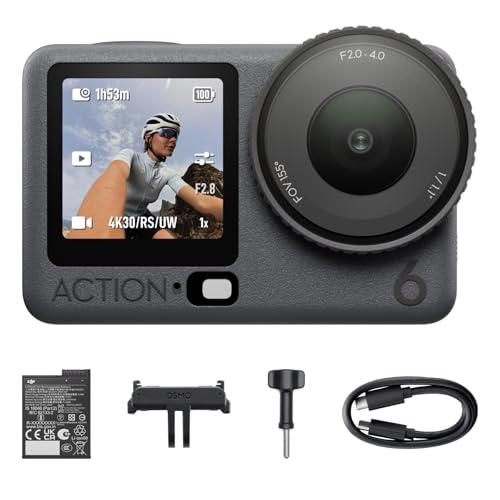
The DJI Osmo Action 6 is an action camera built around a 1/1.1-inch square sensor and an f/2.0 to f/4.0 variable aperture. You get up to 8K video capture, 20-meter waterproofing without a housing, and up to 4 hours of run time. It suits you if you need deep native water resistance and high-resolution recording across changing lighting conditions.
- 1/1.1-inch square sensor supporting 8K video recording
- Physical variable aperture from f/2.0 to f/4.0
- Waterproof down to 20 meters without an added case
- Integrated 50GB internal storage with direct dual-mic pairing
- 360° HorizonSteady stabilization limits video capture to 4K/60fps
- 5.26-ounce weight makes it heavier than ultralight wearable options
- You dive up to 20 meters deep without using an external housing.
- You want 8K footage with adjustable aperture control for changing light.
- You record multi-hour sessions that demand up to 4 hours of battery life.
- You require full 360° horizon leveling at resolutions higher than 4K/60fps.
- You need a miniature wearable camera weighing under 5 ounces.
Verdict: DJI Osmo Action 6 8K Action Camera delivers 20-meter bare-camera waterproofing, adjustable optics, and high-resolution 8K recording for water-sports creators and all-weather videographers.

Insta360 Luna Dual-Lens 8K Camera
Best for: telephoto vlogging and remote-monitored video production
- Video Resolution
- 8K30fps
- Sensor Size
- 1" and 1/1.3"
- Stabilization
- 3-axis mechanical
- Battery Life
- up to 4 hours
- Features
- Touchscreen
- Recommended Use
- Vlogging
The Insta360 Luna is an 8K vlogging camera built around dual Leica lenses, pairing a 1-inch main sensor with a 1/1.3-inch telephoto lens. It features 3-axis mechanical stabilization, up to 15x zoom, and a detachable 2-inch OLED screen that functions as a wireless remote up to 20 meters away. It suits creators prioritizing optical reach and log recording.
- Dual Leica camera system with 1-inch and 1/1.3-inch sensors
- Detachable 2-inch OLED touchscreen with 20-meter wireless control
- 3-axis mechanical stabilization with AI tracking
- Up to 4 hours of battery life
- No waterproof rating specified in product data
- Larger 6.07-inch tall form factor than traditional action cameras
- 8K video recording capped at 30 frames per second
- You need telephoto framing with optical zoom up to 6x and 15x total reach.
- You want a detachable wireless monitor to frame shots up to 20 meters away.
- You require 10-bit I-Log capture with 14 stops of dynamic range.
- You need a fully waterproof action camera for underwater use.
- You prefer a tiny, traditional box-style action camera under 6 inches tall.
Verdict: Insta360 Luna 8K Dual-Lens Camera delivers multi-focal 8K capture and mechanical stabilization for solo vloggers who need optical zoom and remote monitoring. It trades rugged waterproof durability for dual-lens optics and detachable screen flexibility.

DJI Osmo Action 5 Pro 4K Action Camera
Best for: deep diving and cold-weather sports recording
- Video Resolution
- 4K/120fps
- Sensor Size
- 1/1.3"
- Stabilization
- 360° HorizonSteady
- Battery Life
- Up to 4 hours
- Waterproof Depth
- 20m
- Features
- Stabilization
The DJI Osmo Action 5 Pro pairs a 1/1.3-inch sensor with 4K recording up to 120 fps. Its 1950mAh battery delivers up to 4 hours of run time, while the chassis handles depths down to 20 meters without housing. Dual OLED touchscreens provide direct framing control. This setup suits you if you need cold-weather endurance and deep waterproofing.
- Native 20-meter waterproofing without external housing
- Battery runtime reaches up to 4 hours with 1950mAh capacity
- Dual OLED touchscreens on front and rear
- Direct wireless audio support for DJI Mic transmitters
- Maximum video resolution caps at 4K rather than 5.3K or 8K
- Body weight of 5.15 ounces is heavier than miniature wearable models
- You dive up to 20 meters deep without buying an extra protective case.
- You record in sub-zero environments down to -20°C (-4°F).
- You want front and rear OLED displays for vlog framing.
- You require recording resolutions higher than 4K.
- You want an ultralight miniature camera designed strictly for unobtrusive body mounting.
Verdict: DJI Osmo Action 5 Pro 4K Camera fits action sports vloggers who prioritize 20-meter native waterproofing and extended battery life over capture resolutions beyond 4K.
DJI Osmo Nano 4K Wearable Camera
Best for: compact hands-free POV vlogging and sports
- Video Resolution
- 4K/60fps
- Sensor Size
- 1/1.3″
- Battery Life
- Up to 200 minutes
- Waterproof Depth
- 10m
- Field Of View
- 143°
- Dimensions
- 2.33 × 2.72 × 1.09 inches
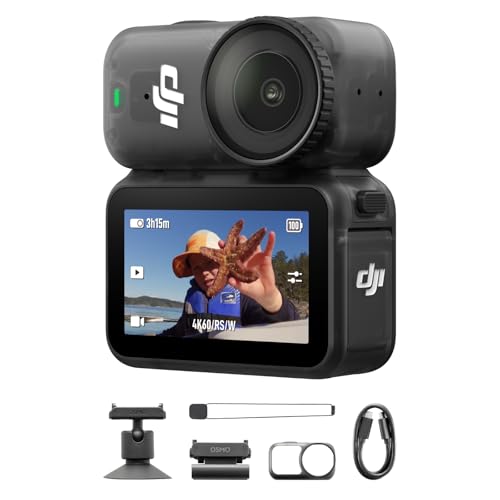
The DJI Osmo Nano is a compact, wearable action camera equipped with a 1/1.3-inch sensor and 128GB of internal storage. You can capture video at up to 4K at 60 frames per second across a 143-degree field of view. It suits you if you need a lightweight magnetic camera with 200-minute battery life for hands-free point-of-view recording.
- Large 1/1.3-inch sensor with 10-bit and D-Log M color support
- Built-in 128GB storage with microSD expansion capability
- Up to 200 minutes of battery runtime with fast charging
- Camera body is waterproof down to 10 meters
- Video resolution caps at 4K at 60fps rather than 5.3K or 8K
- Vision Dock carries only an IPX4 splash resistance rating
- You want internal storage ready for filming without inserting a memory card first.
- You need extended continuous recording up to 200 minutes in a magnetic wearable form factor.
- You plan to color grade your clips using 10-bit or D-Log M profiles.
- You need capture resolutions above 4K at 60fps.
- You need full water submersion while using the Vision Dock accessory.
Verdict: DJI Osmo Nano 4K Wearable Camera delivers long battery runtime and dependable low-light capture for creators prioritizing compact POV mounting over resolutions past 4K.
Specifications side by side
| Spec | Insta360 GO 3S 128GB 4K Action Camera | DJI Osmo Action 4 4K Action Camera | GoPro HERO12 Black 5.3K Action Camera | Insta360 X6 8K 360 Camera | DJI Osmo Action 6 8K Action Camera | Insta360 Luna Dual-Lens 8K Camera | DJI Osmo Action 5 Pro 4K Action Camera | DJI Osmo Nano 4K Wearable Camera |
|---|---|---|---|---|---|---|---|---|
| Video Resolution | 4K | 4K/120fps | 5.3K60 | 8K50fps | 8K, 4K/60fps | 8K30fps | 4K/120fps | 4K/60fps |
| Sensor Size | – | 1/1.3-inch | 1/1.9" | 1/1.1" | 1/1.1″ | 1" and 1/1.3" | 1/1.3" | 1/1.3″ |
| Stabilization | FlowState Stabilization | – | HyperSmooth 6.0 | – | 360° HorizonSteady, RockSteady 3.0 | 3-axis mechanical | 360° HorizonSteady | – |
| Battery Life | 140 minutes | Up to 150 minutes | – | 140 minutes | Up to 4 hours | up to 4 hours | Up to 4 hours | Up to 200 minutes |
| Waterproof Depth | 10m | 18m | 33ft (10m) | – | 20m | – | 20m | 10m |
| Photo Resolution | – | – | 27MP | – | – | – | – | – |
| Field Of View | – | 155° | – | 170° | – | – | – | 143° |
| Camera Configuration | – | – | – | 360 Camera | – | – | – | – |
| Features | Stabilization | – | Stabilization, Live Streaming, Webcam Mode | – | – | Touchscreen | Stabilization | – |
| Recommended Use | Vlogging | – | – | – | – | Vlogging | Vlogging | – |
| Dimensions | 24.8 × 25.6 × 54.4 inches | 2.78 × 1.74 × 1.29 inches | 1.32 × 2.83 × 2 inches | – | 2.87 × 1.86 × 1.3 inches | 1.3 × 1.99 × 6.07 inches | 2.78 × 1.74 × 1.29 inches | 2.33 × 2.72 × 1.09 inches |
| Weight | 4.52 ounces | 5.11 ounces | 11.5 ounces | – | 5.26 ounces | – | 5.15 ounces | 4.37 ounces |
| Color | Black | Black | Black | Arctic White | – | Stellar White | black | Black |
| Model | GO 3S | AC003 | CHDHX-121-TH | CINSABXA | 6937224126060 | CINSABTA | 6941565989512 | OW001 |
| Size | – | – | – | – | Osmo Action 6 Standard Combo | – | – | 2.50 |
If you need larger sensors and interchangeable lenses, the mirrorless camera buying guide covers hardware options with those specifications.
Frequently asked questions
What is the lightest action camera for hands-free POV mounting?
The DJI Osmo Nano is the lightest option at 4.37 ounces, closely followed by the Insta360 GO 3S at 4.52 ounces. The GO 3S offers magnetic mounting specifically suited for hands-free point-of-view vlogging. Both models record in 4K resolution to maintain clear image quality without adding excess physical bulk to your gear.
Which action cameras support 8K video recording?
Three cameras on our list provide 8K video capture: the Insta360 X6, DJI Osmo Action 6, and Insta360 Luna. The X6 records 8K spherical video with a 1/1.1-inch sensor. The Osmo Action 6 pairs an 8K sensor with 20-meter bare-camera waterproofing, while the Luna uses a 1-inch CMOS sensor with dual-lens optics.
How deep can rugged action cameras go underwater without an external case?
The DJI Osmo Action 6 and DJI Osmo Action 5 Pro deliver bare-camera waterproofing down to 20 meters without an extra housing. Other rugged models, such as the GoPro HERO12 Black, also operate in wet environments without external waterproof cases. You should confirm depth ratings match your dive plans before submerging bare hardware.
What is the advantage of a 1/1.3-inch or 1/1.1-inch image sensor?
Larger sensor sizes capture more light and detail, which improves low-light recording. The DJI Osmo Action 4, Action 5 Pro, and Osmo Nano utilize 1/1.3-inch sensors. Models like the Insta360 X6 and DJI Osmo Action 6 expand sensor dimensions to 1/1.1 inches, offering a larger imaging surface than compact 1/1.9-inch sensor designs.
Can you use an action camera as a webcam or for live streaming?
Yes, select models support streaming and webcam functionality directly. The GoPro HERO12 Black includes dedicated Live Streaming and Webcam Mode features alongside 27MP photo resolution and 5.3K video capture. You can connect it to compatible devices to broadcast live footage or use it for desk conferencing without needing a separate video capture card.
How does a 360-degree action camera differ from a standard action camera?
A 360 camera captures spherical video in every direction at once, allowing you to reframe angles during post-production. The Insta360 X6 uses dual 1/1.1-inch sensors to record 8K spherical scenes. In contrast, standard cameras record a single fixed perspective forward, focusing hardware on direct durability and straightforward framing without requiring reframing software.
Which action cameras are best suited for vlogging?
The Insta360 GO 3S, Insta360 Luna, and DJI Osmo Action 5 Pro are explicitly recommended for vlogging. The GO 3S enables hands-free point-of-view filming, while the Luna provides a touchscreen, optical zoom, and remote monitoring. The Osmo Action 5 Pro balances vlogging utility with 20-meter native waterproofing and 4K stabilization for action creators.